


Page 324 - Complete Birds of Britain and Europe (DK - RSPB)
P. 324
WARBLERS AND ALLIES
       Order Passeriformes    Family Sylviidae       Species Acrocephalus schoenobaenus
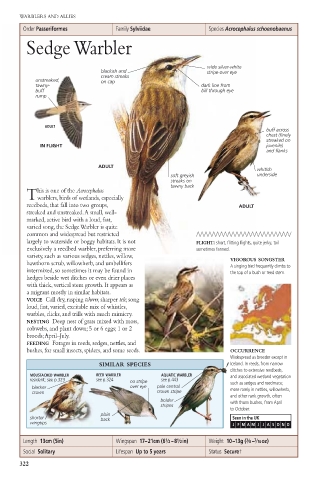
        Sedge Warbler


                                                    wide silver-white
                          blackish and              stripe over eye
                          cream streaks
          unstreaked,     on cap
          tawny-                                   dark line from
          buff                                     bill through eye
          rump

            ADULT
                                                                   buff across
                                                                   chest (finely
                                                                   streaked on
           IN FLIGHT                                               juvenile)
                                                                   and flanks
                         ADULT
                                                                 whitish
                                           soft greyish          underside
                                           streaks on
                                           tawny back
          his is one of the Acrocephalus
        Twarblers, birds of wetlands, especially
        reedbeds, that fall into two groups,                ADULT
        streaked and unstreaked.A small, well-
        marked, active bird with a loud, fast,
        varied song, the Sedge Warbler is quite
        common and widespread but restricted
        largely to waterside or boggy habitats. It is not  FLIGHT: short, flitting flights, quite jerky; tail
        exclusively a reedbed warbler, preferring more  sometimes fanned.
        variety, such as various sedges, nettles, willow,  VIGOROUS SONGSTER
        hawthorn scrub, willowherb, and umbellifers       A singing bird frequently climbs to
        intermixed, so sometimes it may be found in       the top of a bush or reed stem.
        hedges beside wet ditches or even drier places
        with thick, vertical stem growth. It appears as
        a migrant mostly in similar habitats.
        VOICE Call dry, rasping tchrrrr, sharper tek; song
        loud, fast, varied, excitable mix of whistles,
        warbles, clicks, and trills with much mimicry.
        NESTING Deep nest of grass mixed with moss,
        cobwebs, and plant down; 5 or 6 eggs; 1 or 2
        broods;April–July.
        FEEDING Forages in reeds, sedges, nettles, and
        bushes, for small insects, spiders, and some seeds.  OCCURRENCE
                                                          Widespread as breeder except in
                          SIMILAR SPECIES                 Iceland. In reeds, from narrow
                                                          ditches to extensive reedbeds,
        MOUSTACHED WARBLER  REED WARBLER  AQUATIC WARBLER  and associated wetland vegetation
        resident; see p.323  see p.324  no stripe  see p.443  such as sedges and reedmace;
         blacker                 over eye  pale central   more rarely in nettles, willowherb,
         crown                          crown stripe
                                                          and other rank growth, often
                                         bolder           with thorn bushes, from April
                                         stripes
                                                          to October.
                          plain
        shorter           back                             Seen in the UK
        wingtips                                           J  F  M  A  M  JJ A S O  N  D
       Length  13cm (5in)     Wingspan  17–21cm (6 1 ⁄2 –8 1 ⁄2in)  Weight  10–13g ( 3 ⁄8 – 7 ⁄16oz)
       Social  Solitary       Lifespan  Up to 5 years  Status  Secure†
      322

