


Page 326 - Complete Birds of Britain and Europe (DK - RSPB)
P. 326
WARBLERS AND ALLIES
       Order Passeriformes    Family Sylviidae       Species Acrocephalus scirpaceus
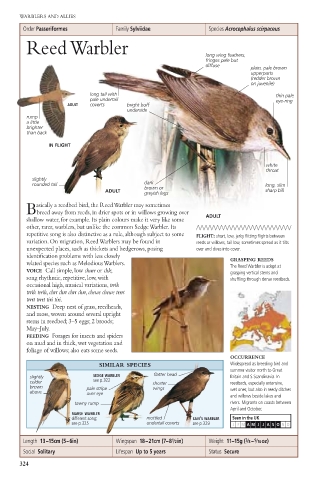
        Reed Warbler
                                                    long wing feathers,
                                                    fringes pale but
                                                    diffuse
                                                               plain, pale brown
                                                               upperparts
                                                               (redder brown
                                                               on juvenile)
                       long tail with                                 thin pale
                       pale undertail                                 eye-ring
                  ADULT  coverts  bright buff
                                 underside
        rump
        a little
        brighter
        than back
             IN FLIGHT
                                                                   white
                                                                   throat
         slightly
         rounded tail                dark                          long, slim
                                     brown or
                           ADULT     greyish legs                  sharp bill
          asically a reedbed bird, the Reed Warbler may sometimes
        Bbreed away from reeds, in drier spots or in willows growing over  ADULT
        shallow water, for example. Its plain colours make it very like some
        other, rarer, warblers, but unlike the common Sedge Warbler. Its
        repetitive song is also distinctive as a rule, although subject to some  FLIGHT: short, low, jerky flitting flights between
        variation. On migration, Reed Warblers may be found in  reeds or willows, tail low, sometimes spread as it tilts
        unexpected places, such as thickets and hedgerows, posing  over and dives into cover.
        identification problems with less closely
        related species such as Melodious Warblers.       GRASPING REEDS
                                                          The Reed Warbler is adept at
        VOICE Call simple, low churr or chk;              grasping vertical stems and
        song rhythmic, repetitive, low, with              shuffling through dense reedbeds.
        occasional high, musical variations, trrik
        trrik trrik, chrr chrr chrr chrr, chewe chewe trrrt
        trrrt trrrt tiri tiri.
        NESTING Deep nest of grass, reedheads,
        and moss, woven around several upright
        stems in reedbed; 3–5 eggs; 2 broods;
        May–July.
        FEEDING Forages for insects and spiders
        on mud and in thick, wet vegetation and
        foliage of willows; also eats some seeds.
                                                          OCCURRENCE
                          SIMILAR SPECIES                 Widespread as breeding bird and
                                                          summer visitor north to Great
        slightly        SEDGE WARBLER  flatter head       Britain and S Scandinavia. In
        colder          see p.322      shorter            reedbeds, especially extensive,
        brown          pale stripe     wings              wet ones, but also in reedy ditches
        above          over eye
                                                          and willows beside lakes and
                    tawny rump                            rivers. Migrants on coasts between
                                                          April and October.
                   MARSH WARBLER
                   different song;   mottled     SAVI’S WARBLER  Seen in the UK
                   see p.325         undertail coverts  see p.329  J  F  M  A  M  JJ A S O  N  D
       Length  13–15cm (5–6in)  Wingspan  18–21cm (7–8 1 ⁄2in)  Weight  11–15g ( 3 ⁄8 – 9 ⁄16oz)
       Social  Solitary       Lifespan  Up to 5 years  Status  Secure
      324

