


Page 328 - Complete Birds of Britain and Europe (DK - RSPB)
P. 328
WARBLERS AND ALLIES
       Order Passeriformes    Family Sylviidae       Species Acrocephalus arundinaceus
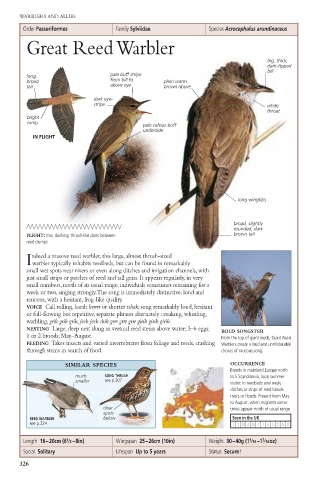
        Great Reed Warbler

                                                                   big, thick,
                                                                   dark-tipped
                                                                   bill
        long,               pale buff stripe
        broad               from bill to  plain warm
        tail                above eye     brown above
                        dark eye-
                        stripe                                     white
                                                                   throat
        bright
        rump
                                     pale rufous-buff
                                     underside
         IN FLIGHT


                                                            long wingtips

                                                           broad, slightly
                                                           rounded, dark
        FLIGHT: low, dashing, thrush-like darts between    brown tail
        reed clumps.
         ndeed a massive reed warbler, this large, almost thrush-sized
        Iwarbler typically inhabits reedbeds, but can be found in remarkably
        small wet spots near rivers or even along ditches and irrigation channels, with
        just small strips or patches of reed and tall grass. It appears regularly, in very
        small numbers, north of its usual range, individuals sometimes remaining for a
        week or two, singing strongly.The song is immediately distinctive: loud and
        raucous, with a hesitant, frog-like quality.
        VOICE Call rolling, harsh krrrrr or shorter tshak; song remarkably loud, hesitant
        or full-flowing but repetitive, separate phrases alternately croaking, whistling,
        warbling, grik grik grik, jeek jeek chik grrr grrr grrr girik girik girik.
        NESTING Large, deep nest slung in vertical reed stems above water; 3–6 eggs;  BOLD SONGSTER
        1 or 2 broods; May–August.                      From the top of giant reeds, Giant Reed
        FEEDING Takes insects and varied invertebrates from foliage and reeds, crashing  Warblers create a loud and unmistakable
        through stems in search of food.                chorus of raucous song.
                 SIMILAR SPECIES                          OCCURRENCE
                                                          Breeds in mainland Europe north
                    much   SONG THRUSH                    to S Scandinavia; local summer
                    smaller  see p.307
                                                          visitor. In reedbeds and reedy
                                                          ditches or strips of reed beside
                                                          rivers or floods. Present from May
                                                          to August, when migrants some-
                           clear                          times appear north of usual range.
                           spots
        REED WARBLER       below                           Seen in the UK
        see p.324                                          JF M A  M J  JA S ON D
       Length  16–20cm (6 1 ⁄2 –8in)  Wingspan  25–26cm (10in)  Weight  30–40g (1 1 ⁄16 –1 7 ⁄16oz)
       Social  Solitary       Lifespan  Up to 5 years  Status  Secure†
      326

