


Page 327 - Complete Birds of Britain and Europe (DK - RSPB)
P. 327
WARBLERS AND ALLIES
       Order Passeriformes    Family Sylviidae       Species Acrocephalus palustris
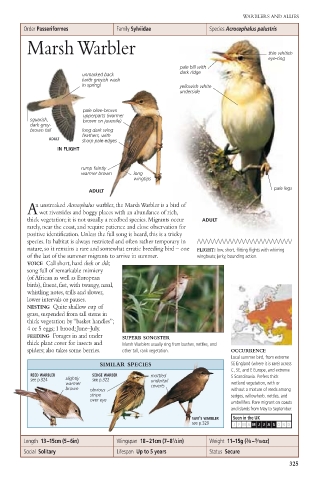
        Marsh Warbler                                               thin whitish

                                                                    eye-ring
                                              pale bill with
                                              dark ridge
                     unmarked back
                     (with greyish wash
                     in spring)               yellowish white
                                              underside
                      pale olive-brown
                      upperparts (warmer
         squarish,    brown on juvenile)
         dark grey-
         brown tail  long dark wing
                     feathers, with
             ADULT   sharp pale edges
               IN FLIGHT
                     rump faintly
                     warmer brown  long
                                  wingtips
                                                                     pale legs
                       ADULT
          n unstreaked Acrocephalus warbler, the Marsh Warbler is a bird of
        A wet riversides and boggy places with an abundance of rich,
        thick vegetation; it is not usually a reedbed species. Migrants occur  ADULT
        rarely, near the coast, and require patience and close observation for
        positive identification. Unless the full song is heard, this is a tricky
        species. Its habitat is always restricted and often rather temporary in
        nature, so it remains a rare and somewhat erratic breeding bird – one  FLIGHT: low, short, flitting flights with whirring
        of the last of the summer migrants to arrive in summer.  wingbeats; jerky, bounding action.
        VOICE Call short, hard chek or chk;
        song full of remarkable mimicry
        (of African as well as European
        birds), fluent, fast, with twangy, nasal,
        whistling notes, trills and slower,
        lower intervals or pauses.
        NESTING Quite shallow cup of
        grass, suspended from tall stems in
        thick vegetation by “basket handles”;
        4 or 5 eggs; 1 brood; June–July.
        FEEDING Forages in and under  SUPERB SONGSTER
        thick plant cover for insects and  Marsh Warblers usually sing from bushes, nettles, and
        spiders; also takes some berries.  other tall, rank vegetation.  OCCURRENCE
                                                          Local summer bird, from extreme
                          SIMILAR SPECIES                 SE England (where it is rare) across
                                                          C, SE, and E Europe, and extreme
         REED WARBLER   SEDGE WARBER  mottled             S Scandinavia. Prefers thick
         see p.324  slightly  see p.322  undertail
                 warmer               coverts             wetland vegetation, with or
                 brown  obvious                           without a mixture of reeds among
                       stripe                             sedges, willowherb, nettles, and
                       over eye
                                                          umbellifers. Rare migrant on coasts
                                                          and islands from May to September.
                                                 SAVI’S WARBLER  Seen in the UK
                                                 see p.329  J  F  M  A  M  JJ A S O  N  D
       Length  13–15cm (5–6in)  Wingspan  18–21cm (7–8 1 ⁄2in)  Weight  11–15g ( 3 ⁄8 – 9 ⁄16oz)
       Social  Solitary       Lifespan  Up to 5 years  Status  Secure
                                                                         325

