


Page 335 - Complete Birds of Britain and Europe (DK - RSPB)
P. 335
WARBLERS AND ALLIES
       Order Passeriformes    Family Sylviidae       Species Phylloscopus trochilus
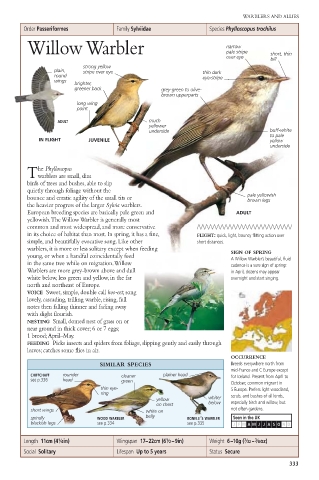
        Willow Warbler                                   narrow
                                                         pale stripe
                                                         over eye   short, thin
                                                                    bill
                      strong yellow
              plain,  stripe over eye              thin dark
              round                                eye-stripe
              wings
                    brighter,
                    greener back         grey-green to olive-
                                         brown upperparts
                    long wing
                    point
               ADULT                  much
                                      yellower
                                      underside                     buff-white
                                                                    to pale
           IN FLIGHT   JUVENILE                                     yellow
                                                                    underside
          he Phylloscopus
        Twarblers are small, slim
        birds of trees and bushes, able to slip
        quietly through foliage without the
        bounce and erratic agility of the small tits or       pale yellowish
                                                              brown legs
        the heavier progress of the larger Sylvia warblers.
        European breeding species are basically pale green and  ADULT
        yellowish.The Willow Warbler is generally most
        common and most widespread, and more conservative
        in its choice of habitat than most. In spring, it has a fine,  FLIGHT: quick, light, bouncy flitting action over
        simple, and beautifully evocative song. Like other  short distances.
        warblers, it is more or less solitary except when feeding  SIGN OF SPRING
        young, or when a handful coincidentally feed      A Willow Warbler’s beautiful, fluid
        in the same tree while on migration.Willow        cadence is a sure sign of spring:
        Warblers are more grey-brown above and dull       in April, dozens may appear
        white below, less green and yellow, in the far    overnight and start singing.
        north and northeast of Europe.
        VOICE Sweet, simple, double call hoo-eet; song
        lovely, cascading, trilling warble, rising, full
        notes then falling thinner and fading away
        with slight flourish.
        NESTING Small, domed nest of grass on or
        near ground in thick cover; 6 or 7 eggs;
        1 brood;April–May.
        FEEDING Picks insects and spiders from foliage, slipping gently and easily through
        leaves; catches some flies in air.
                                                          OCCURRENCE
                          SIMILAR SPECIES                 Breeds everywhere north from
                                                          mid-France and C Europe except
         CHIFFCHAFF  rounder   cleaner    plainer head    for Iceland. Present from April to
         see p.336  head       green
                                                          October; common migrant in
                          thin eye-                       S Europe. Prefers light woodland,
                          ring
                                                     whiter  scrub, and bushes of all kinds,
                                        yellow            especially birch and willow, but
                                        on chest     below
         short wings                 white on             not often gardens.
                                     belly
         spindly         WOOD WARBLER           BONELLI’S WARBLER  Seen in the UK
         blackish legs   see p.334              see p.335  J  F  M  A  M  JJ A S O  N  D
       Length  11cm (4 1 ⁄4in)  Wingspan  17–22cm (6 1 ⁄2 –9in)  Weight  6–10g ( 7 ⁄32 – 3 ⁄8oz)
       Social  Solitary       Lifespan  Up to 5 years  Status  Secure
                                                                         333

