


Page 358 - Complete Birds of Britain and Europe (DK - RSPB)
P. 358
SHRIKES/ORIOLES
        Family Laniidae
                                        SHRIKES

                                           HRUSH-LIKE IN SHAPE and general form,
                                        Tshrikes have stout, sharp, hooked bills and
                                        strong feet, and they are every bit as predatory as
                                        the small falcons.They drop to the ground onto
                                        prey, from a perch, or catch insects and birds in
                                        flight: a shrike will pursue and catch a bird almost
                                        as big as itself.
                                         Shrikes are migratory, the Great Grey Shrike
                                        moving to western Europe in winter, others going
                                        to Africa. Most species are suited to warmer parts
                                        of southern and eastern Europe, where there are
                                        abundant large insects. Intensive farming in many
                                        areas has reduced their numbers and the Red-
                                        backed Shrike has only recently been lost as a
                                        breeding bird in parts of its original range.
                                         Some species have obvious sexual differences in
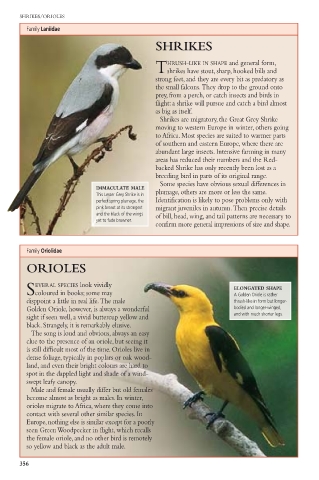
                         IMMACULATE MALE
                         This Lesser Grey Shrike is in  plumage, others are more or less the same.
                         perfect spring plumage, the  Identification is likely to pose problems only with
                         pink breast at its strongest  migrant juveniles in autumn.Then precise details
                         and the black of the wings  of bill, head, wing, and tail patterns are necessary to
                         yet to fade browner.
                                        confirm more general impressions of size and shape.

        Family Oriolidae

        ORIOLES

          EVERAL SPECIES look vividly
                                                           ELONGATED SHAPE
        Scoloured in books; some may                       A Golden Oriole is rather
        disppoint a little in real life.The male           thrush-like in form but longer-
        Golden Oriole, however, is always a wonderful      bodied and longer-winged,
                                                           and with much shorter legs.
        sight if seen well, a vivid buttercup yellow and
        black. Strangely, it is remarkably elusive.
         The song is loud and obvious, always an easy
        clue to the presence of an oriole, but seeing it
        is still difficult most of the time. Orioles live in
        dense foliage, typically in poplars or oak wood-
        land, and even their bright colours are hard to
        spot in the dappled light and shade of a wind-
        swept leafy canopy.
         Male and female usually differ but old females
        become almost as bright as males. In winter,
        orioles migrate to Africa, where they come into
        contact with several other similar species. In
        Europe,nothing else is similar except for a poorly
        seen Green Woodpecker in flight, which recalls
        the female oriole, and no other bird is remotely
        so yellow and black as the adult male.

      356

