


Page 355 - Complete Birds of Britain and Europe (DK - RSPB)
P. 355
NUTHATCHES,WALLCREEPER,AND TREECREEPERS
       Order Passeriformes    Family Tichodromadidae  Species Tichodroma muraria
        Wallcreeper
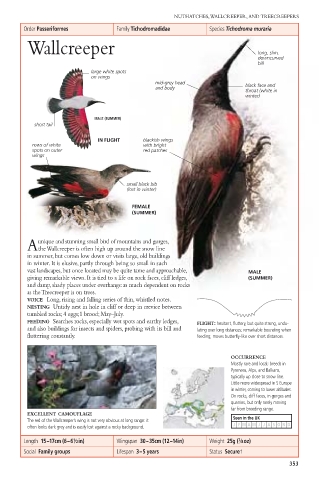
                                                                 long, slim,
                                                                 downcurved
                                                                 bill
                        large white spots
                        on wings
                                        mid-grey head         black face and
                                        and body
                                                              throat (white in
                                                              winter)
                        MALE (SUMMER)
          short tail
                         IN FLIGHT   blackish wings
         rows of white               with bright
         spots on outer              red patches
         wings


                                 small black bib
                                 (lost in winter)

                                  FEMALE
                                  (SUMMER)


          unique and stunning small bird of mountains and gorges,
        Athe Wallcreeper is often high up around the snow line
        in summer, but comes low down or visits large, old buildings
        in winter. It is elusive, partly through being so small in such
        vast landscapes,but once located may be quite tame and approachable,  MALE
        giving remarkable views. It is tied to a life on rock faces, cliff ledges,  (SUMMER)
        and damp, shady places under overhangs: as much dependent on rocks
        as the Treecreeper is on trees.
        VOICE Long, rising and falling series of thin, whistled notes.
        NESTING Untidy nest in hole in cliff or deep in crevice between
        tumbled rocks; 4 eggs;1 brood; May–July.
        FEEDING Searches rocks, especially wet spots and earthy ledges,  FLIGHT: hesitant, fluttery, but quite strong, undu-
        and also buildings for insects and spiders, probing with its bill and  lating over long distances; remarkable bounding when
        fluttering constantly.                    feeding; moves butterfly-like over short distances.

                                                          OCCURRENCE
                                                          Mostly rare and local; breeds in
                                                          Pyrenees, Alps, and Balkans,
                                                          typically up close to snow line.
                                                          Little more widespread in S Europe
                                                          in winter, coming to lower altitudes.
                                                          On rocks, cliff faces, in gorges and
                                                          quarries, but only rarely moving
                                                          far from breeding range.
        EXCELLENT CAMOUFLAGE
                                                           Seen in the UK
        The red of the Wallcreeper’s wing is not very obvious at long range: it
                                                           JF M A  M J  JA S ON D
        often looks dark grey and is easily lost against a rocky background.
       Length  15–17cm (6–6 1 ⁄2in)  Wingspan  30–35cm (12–14in)  Weight  25g ( 7 ⁄8oz)
       Social  Family groups  Lifespan  3–5 years    Status  Secure†
                                                                         353

