


Page 359 - Complete Birds of Britain and Europe (DK - RSPB)
P. 359
SHRIKES
       Order Passeriformes    Family Laniidae        Species Lanius collurio
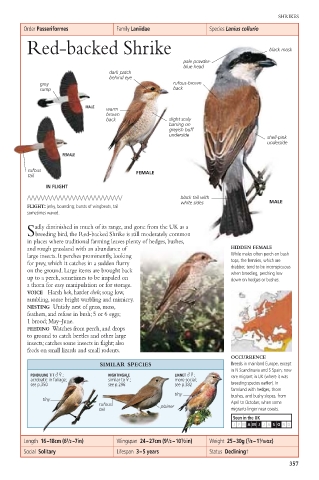
        Red-backed Shrike                                           black mask

                                               pale powder-
                                               blue head
                            dark patch
                            behind eye
           grey                             rufous-brown
           rump                             back
                      MALE
                           warm
                           brown
                           back            slight scaly
                                           barring on
                                           greyish buff
                                           underside
                                                                   shell-pink
                                                                   underside
                 FEMALE
        rufous                     FEMALE
        tail
            IN FLIGHT
                                              black tail with
                                              white sides           MALE
        FLIGHT: jerky, bounding; bursts of wingbeats, tail
        sometimes waved.
          adly diminished in much of its range, and gone from the UK as a
        Sbreeding bird, the Red-backed Shrike is still moderately common
        in places where traditional farming leaves plenty of hedges, bushes,
        and rough grassland with an abundance of          HIDDEN FEMALE
        large insects. It perches prominently, looking    While males often perch on bush
        for prey, which it catches in a sudden flurry     tops, the females, which are
                                                          drabber, tend to be inconspicuous
        on the ground. Large items are brought back       when breeding, perching low
        up to a perch, sometimes to be impaled on         down on hedges or bushes.
        a thorn for easy manipulation or for storage.
        VOICE Harsh hek, harder chek; song low,
        rambling, some bright warbling and mimicry.
        NESTING Untidy nest of grass, moss,
        feathers, and refuse in bush; 5 or 6 eggs;
        1 brood; May–June.
        FEEDING Watches from perch, and drops
        to ground to catch beetles and other large
        insects; catches some insects in flight; also
        feeds on small lizards and small rodents.
                                                          OCCURRENCE
                          SIMILAR SPECIES                 Breeds in mainland Europe, except
                                                          in N Scandinavia and S Spain; now
         PENDULINE TIT 32;  NIGHTINGALE     LINNET 32;    rare migrant in UK (where it was
         acrobatic in foliage;   similar to 2;   more social;
         see p.350          see p.296       see p.382     breeding species earlier). In
                                                          farmland with hedges, thorn
                                            tiny          bushes, and bushy slopes, from
            tiny                                          April to October, when some
                          rufous         plainer
                          tail                            migrants linger near coasts.
                                                           Seen in the UK
                                                           JF M A  M J  JA S O N D
       Length  16–18cm (6 1 ⁄2 –7in)  Wingspan  24–27cm (9 1 ⁄2 –10 1 ⁄2in)  Weight  25–30g ( 7 ⁄8 –1 1 ⁄16oz)
       Social  Solitary       Lifespan  3–5 years    Status  Declining†
                                                                         357

