


Page 377 - Complete Birds of Britain and Europe (DK - RSPB)
P. 377
SPARROWS
       Order Passeriformes    Family Passeridae      Species Passer domesticus
        House Sparrow

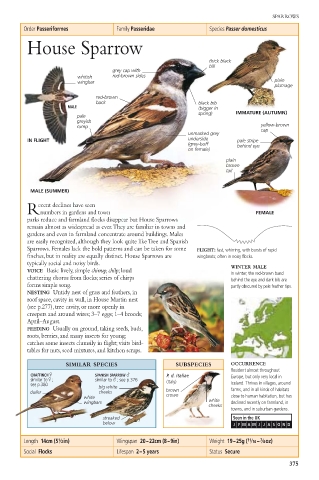
                                                     thick black
                                                     bill
                             grey cap with
                    whitish  red-brown sides
                    wingbar                                          plain
                                                                     plumage
                         red-brown
                         back                     black bib
                  MALE                            (bigger in
                                                  spring)   IMMATURE (AUTUMN)
                    pale
                    greyish
                    rump                                          yellow-brown
                                                                  cap
                                                unmarked grey
        IN FLIGHT                               underside   pale stripe
                                                (grey-buff   behind eye
                                                on female)
                                                         plain
                                                         brown
                                                         tail
         MALE (SUMMER)
          ecent declines have seen
        Rnumbers in gardens and town                             FEMALE
        parks reduce and farmland flocks disappear but House Sparrows
        remain almost as widespread as ever.They are familiar in towns and
        gardens and even in farmland concentrate around buildings. Males
        are easily recognized, although they look quite like Tree and Spanish
        Sparrows. Females lack the bold patterns and can be taken for some  FLIGHT: fast, whirring, with bursts of rapid
        finches, but in reality are equally distinct. House Sparrows are  wingbeats; often in noisy flocks.
        typically social and noisy birds.                 WINTER MALE
        VOICE Basic lively, simple chirrup, chilp; loud   In winter, the red-brown band
        chattering chorus from flocks; series of chirps   behind the eye and dark bib are
        forms simple song.                                partly obscured by pale feather tips.
        NESTING Untidy nest of grass and feathers, in
        roof space, cavity in wall, in House Martin nest
        (see p.277), tree cavity, or more openly in
        creepers and around wires; 3–7 eggs; 1–4 broods;
        April–August.
        FEEDING Usually on ground, taking seeds, buds,
        roots, berries, and many insects for young;
        catches some insects clumsily in flight; visits bird-
        tables for nuts, seed mixtures, and kitchen scraps.
                 SIMILAR SPECIES             SUBSPECIES   OCCURRENCE
                                                          Resident almost throughout
         CHAFFINCH 2     SPANISH SPARROW 3  P. d. italiae  Europe, but only very local in
         similar to 2;   similar to 3; see p.376  (Italy)
         see p.380        big white                       Iceland. Thrives in villages, around
        duller            cheeks          brown           farms, and in all kinds of habitats
                                          crown
                      white                               close to human habitation, but has
                      wingbars                       white  declined recently on farmland, in
                                                     cheeks
                                                          towns, and in suburban gardens.
                           streaked                        Seen in the UK
                           below                           J  F  M  A  M  JJ A S O  N  D
       Length  14cm (5 1 ⁄2in)  Wingspan  20–22cm (8–9in)  Weight  19–25g ( 11 ⁄16 – 7 ⁄8oz)
       Social  Flocks         Lifespan  2–5 years    Status  Secure
                                                                         375

