


Page 392 - Complete Birds of Britain and Europe (DK - RSPB)
P. 392
FINCHES
       Order Passeriformes    Family Fringillidae    Species Pyrrhula pyrrhula
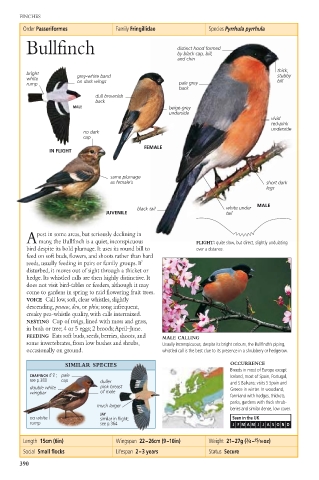
        Bullfinch                            distinct hood formed
                                             by black cap, bill,
                                             and chin
                                                                      thick,
        bright      grey-white band                                   stubby
        white       on dark wings                                     bill
        rump                                 pale grey
                                             back
                         dull brownish
                         back
                   MALE                    beige-grey
                                           underside
                                                                    vivid
                                                                    red-pink
                                                                    underside
                      no dark
                      cap
                                     FEMALE
             IN FLIGHT
                            same plumage
                            as female’s                            short dark
                                                                   legs

                                                                 MALE
                                   black tail            white under
                           JUVENILE                      tail
          pest in some areas, but seriously declining in
        A many, the Bullfinch is a quiet, inconspicuous  FLIGHT: quite slow, but direct, slightly undulating
        bird despite its bold plumage. It uses its round bill to  over a distance.
        feed on soft buds, flowers, and shoots rather than hard
        seeds, usually feeding in pairs or family groups. If
        disturbed, it moves out of sight through a thicket or
        hedge. Its whistled calls are then highly distinctive. It
        does not visit bird-tables or feeders, although it may
        come to gardens in spring to raid flowering fruit trees.
        VOICE Call low, soft, clear whistles, slightly
        descending, peuuw, deu, or phiu; song infrequent,
        creaky pea-whistle quality, with calls intermixed.
        NESTING Cup of twigs, lined with moss and grass,
        in bush or tree; 4 or 5 eggs; 2 broods;April–June.
        FEEDING Eats soft buds, seeds, berries, shoots, and  MALE CALLING
        some invertebrates, from low bushes and shrubs,  Usually inconspicuous, despite its bright colours, the Bullfinch’s piping,
        occasionally on ground.          whistled call is the best clue to its presence in a shrubbery or hedgerow.
                 SIMILAR SPECIES                          OCCURRENCE
                                                          Breeds in most of Europe except
        CHAFFINCH 32; pale                                Iceland, most of Spain, Portugal,
        see p.380  cap    duller                          and S Balkans; visits S Spain and
        double white      pink breast                     Greece in winter. In woodland,
        wingbar           of male
                                                          farmland with hedges, thickets,
                                                          parks, gardens with thick shrub-
                         much larger
                                                          beries and similar dense, low cover.
                          JAY
        no white          similar in flight;               Seen in the UK
        rump              see p.364                        J  F  M  A  M  JJ A S O  N  D
       Length  15cm (6in)     Wingspan  22–26cm (9–10in)  Weight  21–27g ( 3 ⁄4 – 15 ⁄16oz)
       Social  Small flocks   Lifespan  2–3 years    Status  Secure
      390

