


Page 396 - Complete Birds of Britain and Europe (DK - RSPB)
P. 396
BUNTINGS
        Family Emberizidae
        BUNTINGS

           BUNTING LOOKS MUCH like a finch: in
        A general, buntings are a little slimmer and
        longer-tailed, and the structure of the bill is more
        constant, with a small upper mandible fitting
        neatly into a deeper, broader lower one that has
        a curiously curved cutting edge.
         Most buntings have dark tails with white sides,
        but some, such as the Corn Bunting, have plainer
        tails.They show a variety of head patterns. Males
        are much like females in winter, with these
        patterns obscured by dull feather edges, but the
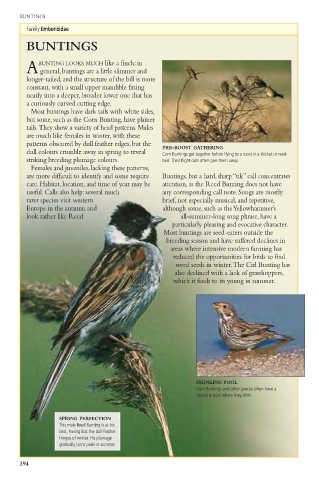
                                         PRE-ROOST GATHERING
        dull colours crumble away in spring to reveal  Corn Buntings get together before flying to a roost in a thicket or reed-
        striking breeding plumage colours.  bed. Their flight calls often give them away.
         Females and juveniles, lacking these patterns,
        are more difficult to identify and some require  Buntings, but a hard, sharp “tik” call concentrates
        care. Habitat, location, and time of year may be  attention, as the Reed Bunting does not have
        useful. Calls also help: several much  any corresponding call note. Songs are mostly
        rarer species visit western      brief, not especially musical, and repetitive,
        Europe in the autumn and         although some, such as the Yellowhammer’s
        look rather like Reed                 all-summer-long song phrase, have a
                                            particularly pleasing and evocative character.
                                          Most buntings are seed-eaters outside the
                                          breeding season and have suffered declines in
                                           areas where intensive modern farming has
                                            reduced the opportunities for birds to find
                                             weed seeds in winter.The Cirl Bunting has
                                            also declined with a lack of grasshoppers,
                                            which it feeds to its young in summer.


                                                  DRINKING POOL
                                                  Corn Buntings and other species often have a
                                                  favourite pool where they drink.

                SPRING PERFECTION
                This male Reed Bunting is at his
                best, having lost the dull feather
                fringes of winter. His plumage
                gradually turns paler in summer.

      394

