


Page 397 - Complete Birds of Britain and Europe (DK - RSPB)
P. 397
BUNTINGS
       Order Passeriformes    Family Emberizidae     Species Emberiza schoeniclus
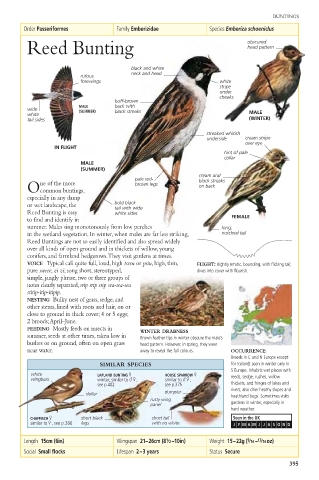
        Reed Bunting                                          obscured
                                                              head pattern

                                  black and white
                                  neck and head
                     rufous
                     forewings                          white
                                                        stripe
                                                        under
                                                        cheeks
                              buff-brown
                     MALE     back with
        wide         (SUMMER)  black streaks
        white                                                  MALE
        tail sides                                             (WINTER)
                                                    streaked whitish
                                                    underside  cream stripe
                                                              over eye
               IN FLIGHT
                                                         hint of pale
                                                         collar
                     MALE
                     (SUMMER)
                                                  cream and
                                   pale red-      black streaks
           ne of the more          brown legs     on back
        Ocommon buntings,
        especially in any damp
        or wet landscape, the  bold black
                             tail with wide
        Reed Bunting is easy   white sides
        to find and identify in                            FEMALE
        summer. Males sing monotonously from low perches  long,
        in the wetland vegetation. In winter, when males are far less striking,  notched tail
        Reed Buntings are not so easily identified and also spread widely
        over all kinds of open ground and in thickets of willow, young
        conifers, and farmland hedgerows.They visit gardens at times.
        VOICE Typical call quite full, loud, high tseeu or psiu, high, thin,  FLIGHT: slightly erratic, bounding, with flicking tail;
        pure sweee; zi zi; song short, stereotyped,  dives into cover with flourish.
        simple, jangly phrase, two or three groups of
        notes clearly separated,srip srip srip sea-sea-sea
        stitip-itip-itipip.
        NESTING Bulky nest of grass, sedge, and
        other stems, lined with roots and hair, on or
        close to ground in thick cover; 4 or 5 eggs;
        2 broods;April–June.
        FEEDING Mostly feeds on insects in  WINTER DRABNESS
        summer, seeds at other times, taken low in  Brown feather tips in winter obscure the male’s
        bushes or on ground, often on open grass  head pattern. However, in spring, they wear
        near water.                 away to reveal the full colours.  OCCURRENCE
                                                          Breeds in C and N Europe except
                          SIMILAR SPECIES                 for Iceland; seen in winter only in
                                                          S Europe. Inhabits wet places with
         white           LAPLAND BUNTING 2  HOUSE SPARROW 2  reeds, sedge, rushes, willow
         wingbars        winter, similar to 32;   similar to 32;
                         see p.402        see p.375       thickets, and fringes of lakes and
                                                          rivers; also drier heathy slopes and
                                          dumpier
                      duller                              heathland bogs. Sometimes visits
                                      rusty wing          gardens in winter, especially in
                                      panel
                                                          hard weather.
         CHAFFINCH 2  short black      short tail          Seen in the UK
         similar to 2; see p.380  legs  with no white      J  F  M  A  M  JJ A S O  N  D
       Length  15cm (6in)     Wingspan  21–26cm (8 1 ⁄2 –10in)  Weight  15–22g ( 9 ⁄16 – 13 ⁄16oz)
       Social  Small flocks   Lifespan  2–3 years    Status  Secure
                                                                         395

