


Page 394 - Complete Birds of Britain and Europe (DK - RSPB)
P. 394
FINCHES
       Order Passeriformes    Family Fringillidae    Species Loxia curvirostra
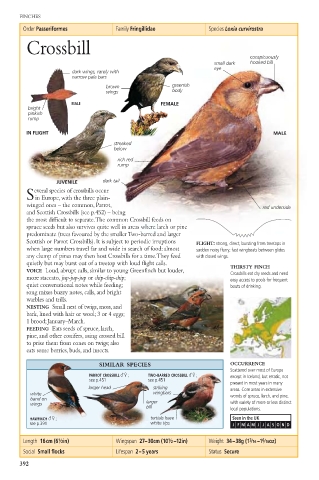
        Crossbill
                                                               conspicuously
                                                      small dark  hooked bill
                                                      eye
                   dark wings, rarely with
                   narrow pale bars
                           brown            greenish
                           wings            body
                   MALE                  FEMALE
        bright
        pinkish
        rump
        IN FLIGHT                                                    MALE
                             streaked
                             below
                              rich red
                              rump

               JUVENILE    dark tail
          everal species of crossbills occur
        S in Europe, with the three plain-
        winged ones – the common, Parrot,                         red underside
        and Scottish Crossbills (see p.452) – being
        the most difficult to separate.The common Crossbill feeds on
        spruce seeds but also survives quite well in areas where larch or pine
        predominate (trees favoured by the smaller Two-barred and larger
        Scottish or Parrot Crossbills). It is subject to periodic irruptions  FLIGHT: strong, direct, bursting from treetops in
        when large numbers travel far and wide in search of food: almost   sudden noisy flurry; fast wingbeats between glides
        any clump of pines may then host Crossbills for a time.They feed  with closed wings.
        quietly but may burst out of a treetop with loud flight calls.  THIRSTY FINCH
        VOICE Loud, abrupt calls, similar to young Greenfinch but louder,  Crossbills eat dry seeds and need
        more staccato, jup-jup-jup or chip-chip-chip;     easy access to pools for frequent
        quiet conversational notes while feeding;         bouts of drinking.
        song mixes buzzy notes, calls, and bright
        warbles and trills.
        NESTING Small nest of twigs, moss, and
        bark, lined with hair or wool; 3 or 4 eggs;
        1 brood; January–March.
        FEEDING Eats seeds of spruce, larch,
        pine, and other conifers, using crossed bill
        to prise them from cones on twigs; also
        eats some berries, buds, and insects.
                          SIMILAR SPECIES                 OCCURRENCE
                                                          Scattered over most of Europe
                       PARROT CROSSBILL 32;  TWO-BARRED CROSSBILL 32;  except in Iceland, but erratic, not
                       see p.451      see p.451
                                                          present in most years in many
                       larger head     striking           areas. Core areas in extensive
         white                         wingbars           woods of spruce, larch, and pine,
         band on
         wings                       larger               with variety of more or less distinct
                                     bill
                                                          local populations.
        HAWFINCH 32;                  tertials have        Seen in the UK
        see p.391                     white tips           J  F  M  A  M  JJ A S O  N  D
       Length  16cm (6 1 ⁄2in)  Wingspan  27–30cm (10 1 ⁄2 –12in)  Weight  34–38g (1 3 ⁄16 –1 6 ⁄16oz)
       Social  Small flocks   Lifespan  2–5 years    Status  Secure
      392

