


Page 420 - Complete Birds of Britain and Europe (DK - RSPB)
P. 420
GAMEBIRDS
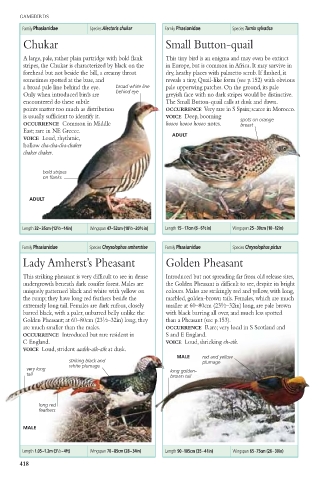
       Family Phasianidae  Species Alectoris chukar  Family Phasianidae  Species Turnix sylvatica
       Chukar                             Small Button-quail

       A large, pale, rather plain partridge with bold flank  This tiny bird is an enigma and may even be extinct
       stripes, the Chukar is characterized by black on the  in Europe, but is common in Africa. It may survive in
       forehead but not beside the bill, a creamy throat  dry, heathy places with palmetto scrub. If flushed, it
       sometimes spotted at the base, and  reveals a tiny, Quail-like form (see p.152) with obvious
       a broad pale line behind the eye.  broad white line  pale upperwing patches. On the ground, its pale
       Only when introduced birds are  behind eye  greyish face with no dark stripes would be distinctive.
       encountered do these subtle        The Small Button-quail calls at dusk and dawn.
       points matter too much as distribution  OCCURRENCE Very rare in S Spain;scarce in Morocco.
       is usually sufficient to identify it.  VOICE Deep, booming   spots on orange
       OCCURRENCE Common in Middle        hoooo hoooo hoooo notes.  breast
       East; rare in NE Greece.
       VOICE Loud, rhythmic,                ADULT
       hollow cha-cha-cha-chaker
       chaker chaker.

            bold stripes
            on flanks

        ADULT


       Length 32–35cm (12 1 ⁄2 –14in)  Wingspan 47–52cm (18 1 ⁄2 –20 1 ⁄2in)  Length 15–17cm (6–6 1 ⁄2in)   Wingspan 25–30cm (10–12in)

       Family Phasianidae  Species Chrysolophus amherstiae  Family Phasianidae  Species Chrysolophus pictus
       Lady Amherst’s Pheasant            Golden Pheasant
       This striking pheasant is very difficult to see in dense  Introduced but not spreading far from old release sites,
       undergrowth beneath dark conifer forest. Males are  the Golden Pheasant is difficult to see, despite its bright
       uniquely patterned black and white with yellow on  colours. Males are strikingly red and yellow, with long,
       the rump; they have long red feathers beside the  marbled, golden-brown tails. Females, which are much
                                                        1
       extremely long tail. Females are dark rufous, closely  smaller at 60–80cm (23 ⁄2–32in) long, are pale brown
       barred black, with a paler, unbarred belly unlike the  with black barring all over, and much less spotted
                          1
       Golden Pheasant; at 60–80cm (23 ⁄2–32in) long, they  than a Pheasant (see p.153).
       are much smaller than the males.   OCCURRENCE Rare; very local in S Scotland and
       OCCURRENCE Introduced but rare resident in   S and E England.
       C England.                         VOICE Loud, shrieking eh-aik.
       VOICE Loud, strident aaahk-aik-aik at dusk.
                                             MALE  red and yellow
                  striking black and               plumage
                  white plumage
        very long                          long golden-
        tail                               brown tail
           long red
           feathers

       MALE


       Length 1.05–1.2m (3 1 ⁄2 –4ft)   Wingspan 70–85cm (28–34in)  Length 90–105cm (35–41in)   Wingspan 65–75cm (26–30in)
      418

