


Page 8 - Complete Birds of Britain and Europe (DK - RSPB)
P. 8
INTRODUCTION

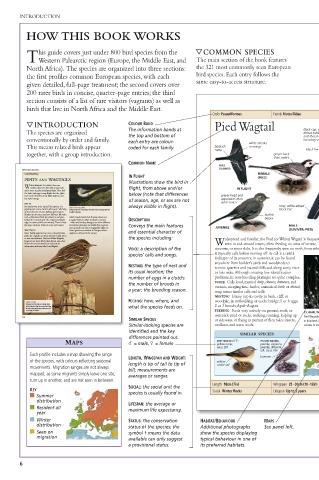
        HOW THIS BOOK WORKS

           his guide covers just under 800 bird species from the  1  COMMON SPECIES
        TWestern Palearctic region (Europe, the Middle East, and  The main section of the book features
        North Africa). The species are organized into three sections:  the 321 most commonly seen European
        the first profiles common European species, with each   bird species. Each entry follows the
        given detailed, full-page treatment; the second covers over   same easy-to-access structure.
        200 rarer birds in concise, quarter-page entries; the third
        section consists of a list of rare visitors (vagrants) as well as
        birds that live in North Africa and the Middle East.
                                                      Order Passeriformes  Family Motacillidae
          INTRODUCTION           COLOUR BAND          Pied Wagtail
         1
        The species are organized  The information bands at                 black cap, c
                                                                            throat (whit
                                 the top and bottom of
        conventionally by order and family.  each entry are colour-         and throat o
                                                                            breeding se
        This means related birds appear  coded for each family.  blackish  white streaks
                                                               on wings
                                                      rump                   black bac
        together, with a group introduction.                         greyer back
                                                                     than male’s
                                 COMMON NAME
                                                        MALE
                                                        (SUMMER)
       PIPITS AND WAGTAILS
       Family Motacillidae                                       FEMALE
                                 IN FLIGHT                       (PIED)
       PIPITS AND WAGTAILS
                                 Illustrations show the bird in
         HILE SIMILAR TO LARKS, these are
       Wsmaller, slimmer birds with longer tails  flight, from above and/or  IN FLIGHT
       and a more steeply undulating flight.They lack
       the larks’ prolonged song-flights but the pipits  below (note that differences
       have more ritualized song-flight patterns and    greyer head and
       less varied songs.                               upperparts than
                                 of season, age, or sex are not
       PIPITS                                           adult male’s
       Streaky brown is the typical description of a  GREY OR YELLOW?  always visible in flight).  long, white-edged
       pipit: species can be hard to tell apart. Calls help,  Although called the Grey Wagtail, this bird confuses many people with   black tail
       as does the time of year, habitat, and location.  its yellow coloration.
       Similar species pairs may have different lifestyles,        buffish
       such as Meadow Pipits (moorland in summer,  which breeds beside fast-flowing streams, is
       lowlands in winter) and Tree Pipits (woodland  a regular bird on urban rooftops in winter.  DESCRIPTION  below
       edge in summer,Africa in winter).There is little  Male and female plumages are often different
       plumage variation between sexes and seasons.  and winter plumages are duller than summer  Conveys the main features  MALE
                  ones; juveniles are also recognizably different.  JUVENILE
       WAGTAILS   Some species are resident in Europe, others  and essential character of  (SUMMER; PIED)
       More boldly patterned or more colourful than  migrate to Africa for the winter.
       pipits,the wagtails are often associated with water
       or wet meadowland. Pied and White Wagtails,  the species including:  idespread and familiar, the Pied (or White) Wagtail is frequent
       however, are more likely than almost any other
       bird to be seen on tarmac or concrete in       Wseen in and around towns, often feeding on areas of tarmac,
       urban areas and even the Grey Wagtail,
                                 VOICE: a description of the  concrete, or stone slabs. It is also frequently seen on roofs, from whi
                                 species’ calls and songs.   it typically calls before moving off: its call is a useful
                                                      indicator of its presence. In summer, it can be found
                                                      anywhere from builder’s yards and woodsheds to
                                 NESTING: the type of nest and
                                                      remote quarries and natural cliffs and along stony river
                                 its usual location; the  or lake sides.Although creating few identification
                                 number of eggs in a clutch;  problems, its non-breeding plumages are quite complex.
                                 the number of broods in   VOICE Calls loud, musical chrip, chuwee, chrruwee, and
                                                      variants, merging into harder, unmusical tissik or chiswit;
                                 a year; the breeding season.  song mixes similar calls and trills.
                                                      NESTING Grassy cup in cavity in bank, cliff, or
                                 FEEDING: how, where, and
       LONG CLAW                                      woodpile, in outbuilding or under bridge; 5 or 6 eggs;
       Meadow and Tree Pipits are closely similar,
       but the Meadow Pipit has a long hind claw,   what the species feeds on.   2 or 3 broods;April–August.
       at least as long as the toe, as seen here: on
       a Tree Pipit it is shorter.                    FEEDING Feeds very actively on ground, roofs, or
                                                                            COMMUN
                                                      waterside mud or rocks, walking, running, leaping up
       278                                                                  Pied Wagtails
                                 SIMILAR SPECIES      or sideways, or flying in pursuit of flies; takes insects,  in hundreds i
                                 Similar-looking species are  molluscs, and some seeds.  centres or ins
                                 identified and the key
                                                             SIMILAR SPECIES
                                 differences pointed out.
                 MAPS            3 = male, 2 = female  GREY WAGTAIL 32;  YELLOW WAGTAIL
                                                                  juvenile, similar to
                                                       yellow rump;
                                                       see p.287  juvenile; different
                                                                  call; see p.286
        Each profile includes a map showing the range
                                 LENGTH, WINGSPAN AND WEIGHT:     browner
        of the species, with colours reflecting seasonal  yellow
                                 length is tip of tail to tip of  under tail
        movements. Migration ranges are not always
                                 bill; measurements are
        mapped, as some migrants simply leave one site,
                                 averages or ranges.
        turn up in another, and are not seen in between.
                                                      Length  18cm (7in)  Wingspan  25–30cm (10–12in)
                                 SOCIAL: the social unit the
        KEY                      species is usually found in.  Social  Winter flocks  Lifespan  Up to 5 years
          Summer
          distribution
                                 LIFESPAN: the average or
          Resident all           maximum life expectancy.
          year
          Winter                 STATUS: the conservation  HABITAT/BEHAVIOUR  MAPS
          distribution           status of the species; the  Additional photographs  See panel left.
          Seen on                symbol † means the data  show the species displaying
          migration              available can only suggest   typical behaviour in one of
                                 a provisional status.  its preferred habitats.
      6

