


Page 11 - Complete Birds of Britain and Europe (DK - RSPB)
P. 11
EVOLUTION

        NATURAL SELECTION
        “Only the fittest survive.” That is the theory of natural selection
        and it is true that the birds best adapted to an environment
        have an advantage over the rest and produce offspring that
        perpetuate their own genetic make-up.There are many
        ways in which a species may evolve in response to changing
        habitats or food. If such a change happens in only one part
        of a species’ range, and the birds in that area remain separate,
        they may change so much that they can no longer interbreed.
        The result is two species instead of one.There is a halfway
        stage: two groups may differ
        in size or colour, but can
        still interbreed.At this
        point they are called
        “subspecies”
        or “races”.

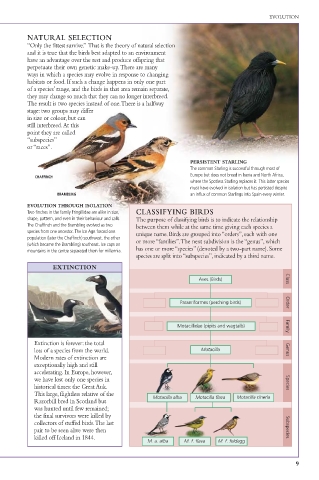
                                                PERSISTENT STARLING
                                                The common Starling is successful through most of
                                                Europe but does not breed in Iberia and North Africa,
          CHAFFINCH
                                                where the Spotless Starling replaces it. This latter species
                                                must have evolved in isolation but has persisted despite
               BRAMBLING                        an influx of common Starlings into Spain every winter.
        EVOLUTION THROUGH ISOLATION
        Two finches in the family Fringillidae are alike in size,  CLASSIFYING BIRDS
        shape, pattern, and even in their behaviour and calls.  The purpose of classifying birds is to indicate the relationship
        The Chaffinch and the Brambling evolved as two  between them while at the same time giving each species a
        species from one ancestor. The Ice Age forced one  unique name.Birds are grouped into “orders”,each with one
        population (later the Chaffinch) southwest, the other
        (which became the Brambling) southeast. Ice caps on  or more “families”.The next subdivision is the “genus”,which
        mountains in the centre separated them for millennia.  has one or more “species”(denoted by a two-part name).Some
                                   species are split into “subspecies”,indicated by a third name.
              EXTINCTION
                                                  Aves (Birds)          Class

                                              Passeriformes (perching birds)   Order


                                             Motacillidae (pipits and wagtails)   Family

          Extinction is forever: the total
          loss of a species from the world.        Motacilla            Genus
          Modern rates of extinction are
          exceptionally high and still
          accelerating. In Europe, however,
          we have lost only one species in                              Species
          historical times: the Great Auk.
          This large, flightless relative of the  Motacilla alba  Motacilla flava  Motacilla cineria
          Razorbill bred in Scotland but
          was hunted until few remained;
          the final survivors were killed by
          collectors of stuffed birds.The last
          pair to be seen alive were then                               Subspecies
          killed off Iceland in 1844.
                                      M. a. alba  M. f. flava  M. f. feldegg


                                                                          9

