


Page 13 - Complete Birds of Britain and Europe (DK - RSPB)
P. 13
ANATOMY

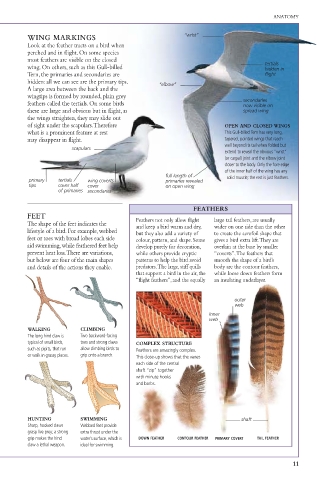
        WING MARKINGS                          “wrist”
        Look at the feather tracts on a bird when
        perched and in flight. On some species
        most feathers are visible on the closed                    tertials
        wing. On others, such as this Gull-billed                  hidden in
        Tern, the primaries and secondaries are                    flight
        hidden: all we can see are the primary tips.  “elbow”
        A large area between the back and the
        wingtips is formed by rounded, plain grey
        feathers called the tertials. On some birds          secondaries
                                                             now visible on
        these are large and obvious but in flight, as        spread wing
        the wings straighten, they may slide out
        of sight under the scapulars.Therefore           OPEN AND CLOSED WINGS
        what is a prominent feature at rest              This Gull-billed Tern has very long,
        may disappear in flight.                         tapered, pointed wings that reach
                                                         well beyond its tail when folded but
                   scapulars
                                                         extend to reveal the obvious “wrist”
                                                         (or carpal) joint and the elbow joint
                                                         closer to the body. Only the fore edge
                                                         of the inner half of the wing has any
                                          full length of  solid muscle; the rest is just feathers.
        primary  tertials  wing coverts   primaries revealed
        tips    cover half  cover         on open wing
                of primaries  secondaries
                                                 FEATHERS
        FEET                       Feathers not only allow flight  large tail feathers, are usually
        The shape of the feet indicates the  and keep a bird warm and dry,  wider on one side than the other
        lifestyle of a bird.For example,webbed  but they also add a variety of  to create the aerofoil shape that
        feet or toes with broad lobes each side  colour, pattern, and shape. Some  gives a bird extra lift.They are
        aid swimming,while feathered feet help  develop purely for decoration,  overlain at the base by smaller
        prevent heat loss.There are variations,  while others provide cryptic  “coverts”.The feathers that
        but below are four of the main shapes  patterns to help the bird avoid  smooth the shape of a bird’s
        and details of the actions they enable.  predators.The large, stiff quills  body are the contour feathers,
                                   that support a bird in the air, the  while loose down feathers form
                                   “flight feathers”, and the equally  an insulating underlayer.

                                                           outer
                                                           web
                                                     inner
                                                     web
        WALKING      CLIMBING
        The long hind claw is  Two backward-facing
        typical of small birds,   toes and strong claws  COMPLEX STRUCTURE
        such as pipits, that run   allow climbing birds to  Feathers are amazingly complex.
        or walk in grassy places.  grip onto a branch.  This close-up shows that the vanes
                                   each side of the central
                                   shaft “zip” together
                                   with minute hooks
                                   and barbs.


        HUNTING      SWIMMING                                shaft
        Sharp, hooked claws  Webbed feet provide
        grasp live prey; a strong  extra thrust under the
        grip makes the hind   water’s surface, which is  DOWN FEATHER  CONTOUR FEATHER  PRIMARY COVERT  TAIL FEATHER
        claw a lethal weapon.  ideal for swimming.

                                                                          11

