


Page 9 - Complete Birds of Britain and Europe (DK - RSPB)
P. 9
HOW THIS BOOK WORKS
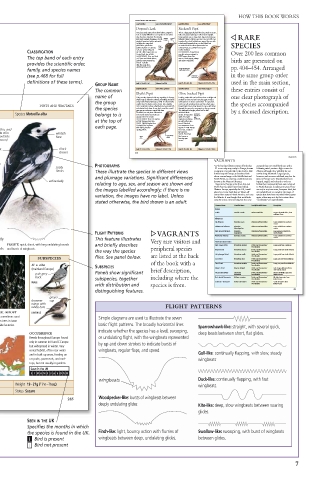
LARKS/PIPITS AND WAGTAILS
Family Alaudidae Species Chersophilus duponti Family Motacillidae Species Anthus richardi
Dupont’s Lark Richard’s Pipit
In its hot, sandy, open, often saline habitat, Dupont’s This is a large pipit, Skylark-like (see p.265) in its size,
Lark is usually difficult to see: it prefers to run rather bulk, and general plumage. It often stands upright,
than fly when disturbed.This streaky breast pushed out, on long, thick legs, its bold, strong 1
lark stands upright, showing a closely flattish curved bill quite distinct.There is no trace of a crest.The face RARE
bill
crown
streaked breast and white underside. is marked by a bold whitish area around the eye with
In flight, the wings look a dark mark beneath; there is a thick black line
plain above, pale below long, on each side of the throat (less marked on SPECIES
(unlike Skylark or Calandra narrow a Tawny Pipit, see p.279).The long tail
Lark, see p.265, 270), and neck is often bobbed.
CLASSIFICATION the tail a little longer than on OCCURRENCE Regular, but
Crested Lark (see p.266). rare, late autumn migrant in Over 200 less common
The top band of each entry OCCURRENCE Rare and local NW Europe, from Asia.
in E Spain and North Africa,
VOICE Loud, rasping schreep
in short, sparse, vegetation. and quieter variations. birds are presented on
provides the scientific order, VOICE Call thin
choo-chee; song short,
whistling, fluty notes. long blackish tail pp. 404–454. Arranged
family, and species names with white sides
(see p.468 for full very long in the same group order
hind claws
definitions of these terms). Length 17–18cm (6 1 ⁄2 –7in) Wingspan 30cm (12in) Length 17–20cm (6 1 ⁄2 –8in) Wingspan 29–33cm (11 1 ⁄2 –13in) used in the main section,
GROUP NAME
The common Family Motacillidae Species Anthus godlewski Family Motacillidae Species Anthus hodgsoni these entries consist of
Blyth’s Pipit Olive-backed Pipit
name of Only recently observed with any regularity in Europe, Looking rather dark and uniform above or bright and one clear photograph of
Blyth’s Pipit is difficult to identify,resembling Richard’s streaked in front in a brief view, this pipit reveals a
the group and juvenile Tawny Pipits (see p.279). It is fractionally subtle pattern on closer examination. It is greenish, the species accompanied
smaller than Richard’s, with a shorter tail, a slightly
with very soft streaking above, and has a dark cap, a
PIPITS AND WAGTAILS richer underside colour, a slightly shorter, pointed bill, broad, bright cream stripe above the eye, a dark stripe
the species and shorter hind claws. It may look more like a small through the eye, and a cream spot on the ear coverts.
pipit species and more wagtail-like than
The underside is bright yellow-buff to buff
Species Motacilla alba belongs to is Richard’s, but only close observation with bold black bold dark by a focused description.
streaks. It frequently
and several clearly heard calls can
separate them for certain. walks in longish streaks on
pale
at the top of OCCURRENCE Very rare vagrant vegetation, bobbing underside
its tail, but flies into
in NW Europe, from Asia.
VOICE Slightly higher than trees if disturbed.
each page. Richard’s, less explosive, OCCURRENCE Rare
with fading, breathy
vagrant in NW Europe
chin, and quality, psh-eee. from Asia, mostly in
late autumn.
te chin whitish VOICE Tree Pipit-
outside face short tail wagtail-like like hoarse or
shape
buzzing spees
eason) or tees.
ck black Length 15–17cm (6–6 1 ⁄2in) Wingspan 28–30cm (11–12in) Length 14–15cm (5 1 ⁄2 –6in) Wingspan 24–27cm (9 1 ⁄2 –10 1 ⁄2in)
breast 438
VAGRANTS
VAGRANTS
PHOTOGRAPHS he list that follows consists of birds that accepted that even small birds can, with a
sooty Toccur only very rarely in Europe, known following wind, survive a flight across the
flanks These illustrate the species in different views as vagrants or accidentals. It also looks a little Atlantic, although they probably do not
further beyond Europe, to list those birds
survive long afterwards. Larger species,
and plumage variations. Significant differences whose normal range is the Middle East and however, such as some wildfowl, may live for
years in Europe and a few (that have been
North Africa, so covering a total faunal area
white belly known as the Western Palearctic. trapped, ringed, and released in order to
relating to age, sex, and season are shown and Vagrants to Europe arrive from Asia and follow their movements) have even returned
North America (and fewer from Africa). to North America in subsequent years.These
the images labelled accordingly; if there is no Western Europe, especially the UK, is well are not, in any true sense, European birds, but
placed to receive birds that are blown off are included here to complete the range of
variation, the images have no label. Unless course from eastern North America and cross species that have been recorded. Many appear
again, others may not: by their nature these
the Atlantic. It was thought that such birds
stated otherwise, the bird shown is an adult. cross the ocean on board ship, but it is now “accidentals” are unpredictable.
Common Name Scientific Name Family/Scientific Name Description
Ostrich
Ostrich Struthio camelus Ratites/Struthidae Vagrant in North Africa, from
southern Africa
Albatrosses
Shy Albatross Diomedea cauta Albatrosses/Diomedeidae Large seabird from southern
oceans
Yellow-nosed Albatross Diomedea Albatrosses/Diomedeidae Large seabird from southern
chlororhynchos oceans
FLIGHT PATTERNS 1 VAGRANTS Black-browed Albatross Diomedea Albatrosses/Diomededae Long-winged seabird from
melanophris
South Atlantic
Albatrosses/Diomedeidae
Diomedea exulans
Wandering Albatross
Large seabird from southern
tly This feature illustrates Very rare visitors and Petrels and Shearwaters oceans
FLIGHT: quick, direct, with long undulating bounds and briefly describes Black-capped Petrel Pterodroma hasitata Petrels and Shearwaters/ Large petrel from Caribbean
ch and bursts of wingbeats. peripheral species Atlantic Petrel Pterodroma incerta Procellariidae Large petrel from South Atlantic
Petrels and Shearwaters/
the way the species Soft-plumaged Petrel Pterodroma mollis Procellariidae Large petrel from South Atlantic
Petrels and Shearwaters/
SUBSPECIES flies. See panel below. are listed at the back Fea's Petrel Pterodroma feae Procellariidae Large, rare petrel from Madeira
Petrels and Shearwaters/
Procellariidae
of the book with a Zino's Petrel Pterodroma madeira Petrels and Shearwaters/ Large, rare petrel from Madeira
M. a. alba SUBSPECIES Procellariidae
(mainland Europe) Panels show significant brief description, Bulwer's Petrel Bulweria bulwerii Petrels and Shearwaters/ Dark, long-tailed petrel from
Procellariidae
mid-Atlantic islands
pale grey Streaked Shearwater Calonectris Petrels and Shearwaters/ Vagrant in Middle East, from
tropical oceans
leucomelas
Procellariidae
back subspecies, together including where the Flesh-footed Shearwater Puffinus carneipes Petrels and Shearwaters/ All-dark shearwater from
Procellariidae
Indian Ocean
MALE Audubon's Shearwater Puffinus lherminieri Petrels and Shearwaters/ Small shearwater from
with distribution and species is from.
Indian Ocean
Procellariidae
distinguishing features. 455
greyer
browner cap
wings with FLIGHT PATTERNS
white bars
NAL ROOST JUVENILE
s sometimes roost Simple diagrams are used to illustrate the seven
n trees in town
side factories. basic flight patterns. The broadly horizontal lines
Sparrowhawk-like: straight, with several quick,
indicate whether the species has a level, swooping,
OCCURRENCE deep beats between short, flat glides.
Breeds throughout Europe; found or undulating flight, with the wingbeats represented
only in summer in N and E Europe by up and down strokes to indicate bursts of
but widespread in winter. Very
varied habitat, often near water wingbeats, regular flaps, and speed. Gull-like: continually flapping, with slow, steady
and in built-up areas, feeding on
car parks, pavements, and roof- wingbeats
tops, but not usually in gardens.
Seen in the UK
J F M A M JJ A S O N D
wingbeats Duck-like: continually flapping, with fast
Weight 19–27g ( 11 ⁄16 – 7 ⁄8oz) wingbeats.
Status Secure
Woodpecker-like: bursts of wingbeats between
285
deeply undulating glides. Kite-like: deep, slow wingbeats between soaring
glides.
SEEN IN THE UK
Specifies the months in which
the species is found in the UK. Finch-like: light, bouncy action with flurries of Swallow-like: swooping, with burst of wingbeats
J Bird is present wingbeats between deep, undulating glides. between glides.
J Bird not present
7

