


Page 12 - Complete Birds of Britain and Europe (DK - RSPB)
P. 12
INTRODUCTION

        ANATOMY

          lthough there is a huge diversity in shape,  Their bones are like ours,but the proportions are
        Asize, and outer appearance,all birds have a  very different.For example,the wing bones are
        similar internal structure.They are vertebrates,  like a human arm;the “inner wing”equivalent to
        so have a jointed internal skeleton with two  our forearm,and the “outer wing”like the bones
        forelimbs and two hindlimbs,just like fish,  of our hand.What makes them unique is that
        reptiles,and mammals – including humans.  they are the only animals with feathers.

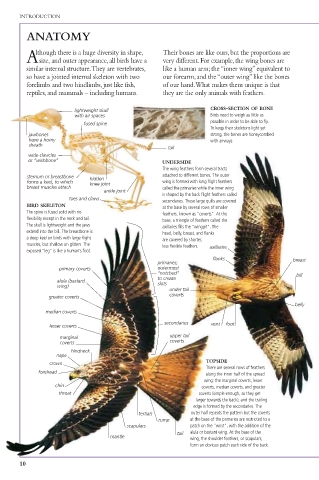
                    lightweight skull                CROSS-SECTION OF BONE
                    with air spaces                  Birds need to weigh as little as
                                                     possible in order to be able to fly.
                      fused spine
                                                     To keep their skeletons light yet
        jawbones                                     strong, the bones are honeycombed
        have a horny                                 with airways.
        sheath
                                           tail
        wide clavicles
        or “wishbone”                    UNDERSIDE
                                         The wing feathers form several tracts
        sternum or breastbone  hidden    attached to different bones. The outer
        forms a keel, to which  knee joint   wing is formed with long flight feathers
        breast muscles attach            called the primaries while the inner wing
                           ankle joint
                                         is shaped by the back flight feathers called
                  toes and claws
                                         secondaries. These large quills are covered
        BIRD SKELETON                    at the base by several rows of smaller
        The spine is fused solid with no  feathers, known as “coverts”. At the
        flexibility except in the neck and tail.  base, a triangle of feathers called the
        The skull is lightweight and the jaws  axillaries fills the “wingpit”. The
        extend into the bill. The breastbone is  head, belly, breast, and flanks
        a deep keel on birds with large flight  are covered by shorter,
        muscles, but shallow on gliders. The  less flexible feathers.  axillaries
        exposed “leg” is like a human’s foot.
                                                      flanks              breast
                                        primaries;
                primary coverts         outermost
                                        “notched”                          bill
                                        to create
               alula (bastard           slots
               wing)
                                           under tail
             greater coverts               coverts
                                                                          belly
            median coverts
                                          secondaries  vent  foot
             lesser coverts
                                           upper tail
                marginal
                coverts                    coverts
                   hindneck
               nape
                                                    TOPSIDE
             crown
                                                    There are several rows of feathers
           forehead                                 along the inner half of the spread
                                                    wing: the marginal coverts, lesser
               chin                                coverts, median coverts, and greater
                throat                            coverts (simple enough, as they get
                                                  larger towards the back), and the trailing
                                                 edge is formed by the secondaries. The
                                   tertials     outer half repeats the pattern but the coverts
                                        rump    at the base of the primaries are restricted to a
                                 scapulars      patch on the “wrist”, with the addition of the
                                             tail  alula or bastard wing. At the base of the
                            mantle              wing, the shoulder feathers, or scapulars,
                                                form an obvious patch each side of the back.
      10

