


Page 38 - (DK Eyewitness) Travel Guide - Spain
P. 38
36 INTRODUCING SP AIN
Spanish Art
Three Spanish painters stand out as milestones in the history
of Western art. Diego de Velázquez was a 17th-century court The king and queen,
portrait painter and his Las Meninas is a seminal work. Francisco reflected in a mirror
de Goya depicted Spanish life during one of its most violent be hind the painter,
may be posing for
periods. The prolific 20th-century master Pablo Picasso is recog- Self-portrait their portrait.
nized as the founder of modern art. To these names must be of Velázquez
added that of El Greco – who was born in Crete but who lived
in Spain, where he painted religious scenes in an indi vidualistic
style. The work of these and Spain’s many other great artists can
be seen in world- renowned
galleries, especially the Prado
(see pp296–9).
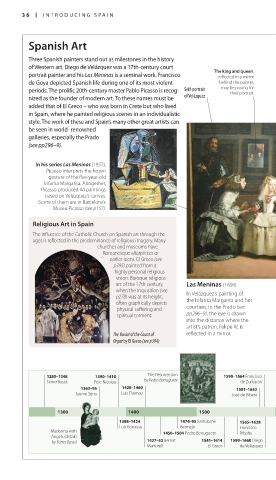
In his series Las Meninas (1957),
Picasso interprets the frozen
gesture of the five-year-old
Infanta Margarita. Altogether,
Picasso produced 44 paintings
based on Velázquez’s canvas.
Some of them are in Barcelona’s
Museu Picasso (see p157).
Religious Art in Spain
The influence of the Catholic Church on Spanish art through the
ages is reflected in the predominance of religious imagery. Many
churches and museums have
Romanesque altarpieces or
earlier icons. El Greco (see
p395) painted from a
highly personal religious
vision. Baroque religious
art of the 17th century, Las Meninas (1656)
when the In quisition (see
p278) was at its height, In Velázquez’s painting of
often graphically depicts the Infanta Margarita and her
physical suffering and courtiers, in the Prado (see
spiritual torment. pp296–9), the eye is drawn
into the distance where the
artist’s patron, Felipe IV, is
The Burial of the Count of reflected in a mirror.
Orgaz by El Greco (see p394)
1285–1348 1390–1410 The Resurrection 1598–1664 Francisco
Ferrer Bassá Pere Nicolau by Pedro Berruguete de Zurbarán
1363–95 1428–1460 1591–1652
Jaume Serra Luis Daimau José de Ribera
1300 1400 1500
1388–1424 1474–95 Bartolomé 1565–1628
Luis Borrassa Bermejo Francisco
Madonna with 1450–1504 Pedro Berruguete Ribalta
Angels (detail)
by Ferrer Bassá 1427–52 Bernat 1541–1614 1599–1660 Diego
Martorell El Greco de Velázquez
036-037_EW_Spain.indd 36 26/09/17 11:52 am

