


Page 31 - Dog
P. 31
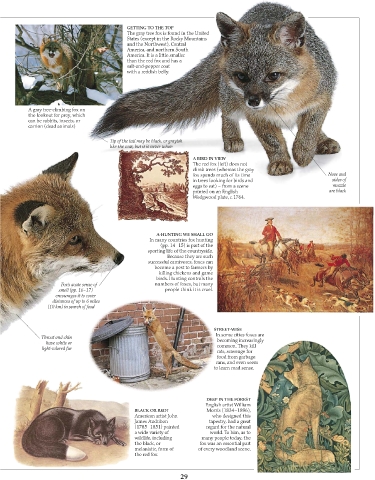
GETTING TO THE TOP
The gray tree fox is found in the United
States (except in the Rocky Mountains
and the Northwest), Central
America, and northern South
America. It is a little smaller
than the red fox and has a
salt-and-pepper coat
with a reddish belly.
A gray tree-climbing fox on
the lookout for prey, which
can be rabbits, insects, or
carrion (dead animals)
Tip of the tail may be black, or grayish
like the coat, but it is never white
A BIRD IN VIEW
The red fox (left) does not
climb trees (whereas the gray
fox spends much of its time Nose and
in trees looking for birds and sides of
eggs to eat) – from a scene muzzle
printed on an English are black
Wedgwood plate, c.1764.
AHUNTING WE SHALL GO
In many countries fox hunting
(pp. 14–15) is part of the
sporting life of the countryside.
Because they are such
successful carnivores, foxes can
become a pest to farmers by
killing chickens and game
birds. Hunting controls the
Fox’s acute sense of numbers of foxes, but many
smell (pp. 16–17) people think it is cruel.
encourages it to cover
distances of up to 6 miles
(10 km) in search of food
STREETWISE
In some cities foxes are
Throat and chin
have white or becoming increasingly
light-colored fur common. They kill
rats, scavenge for
food from garbage
cans, and even seem
to learn road sense.
DEEP IN THE FOREST
English artist William
BLACK OR RED? Morris (1834–1896),
American artist John who designed this
James Audubon tapestry, had a great
(1785–1851) painted regard for the natural
a wide variety of world. To him, as to
wildlife, including many people today, the
the black, or fox was an essential part
melanistic, form of of every woodland scene.
the red fox.
29
(c) 2011 Dorling Kindersley. All Rights Reserved.

