


Page 32 - Dog
P. 32
Hot foxes, cold foxes


                              Not all species of foxes live in the
              HOT DOG!
          The hot dog, called a   temperate (moderate) parts of the world
          frankfurter in Europe,   and feed off the abundant rats, mice, and
            was first made in
          Germany during the   small birds there. A few foxes live
             Middle Ages.      exceedingly harsh lives in the coldest –
        as well as in the hottest – lands. Only one fox lives in the icy
        cold Arctic regions of Alaska, Canada, northern Europe, and
                                                                                                              DESERT FOX
        Asia, and that is the Arctic fox. Arctic foxes have been known to cover a                       The fennec fox is the
        territory of 15,000 acres (6,000 hectares) in their search for food; they have                smallest of all the foxes,
                                                                                                       and it probably has the
        small ears, which cut down on heat loss, and dense fur, which keeps them                      most difficult time of all
        warm in winter. There are also a number of different species of fox that live                in finding food. It lives in
                                                                                                     the parched Arabian and
        in the world’s hottest deserts. Generally, very little food is available for these              Sahara deserts where
        foxes, so they have evolved as hunters and scavengers; they range over                        there are very few other
                                                                                                          animals, so food is
        huge areas in search of some food to keep them alive. Foxes that live in hot,                        always scarce.
        dry deserts all have very large ears which help keep them cool, small bodies
        that can survive on little food, and short, dense fur. They sleep in dens, or               Soft, dense coat is
        hollows in the sand, during the intense heat of the day, and hunt by night                  designed to keep the
                                                                                                    Arctic fox warm and
        when it can actually be very cold.                                                          is thicker in winter
        Short, furry ears
        cut down heat                                         Dark brown and
        loss – in winter                                      white summer coat
        they must not
        become frost-
        bitten
                                                                        Adult’s tail is
                                                                        very bushy, and
                                                                        can be as long as
                                                                        12 in (30 cm)


                                             Arctic
                                             fox cub
                                             in dark
                                             summer
                                             coat

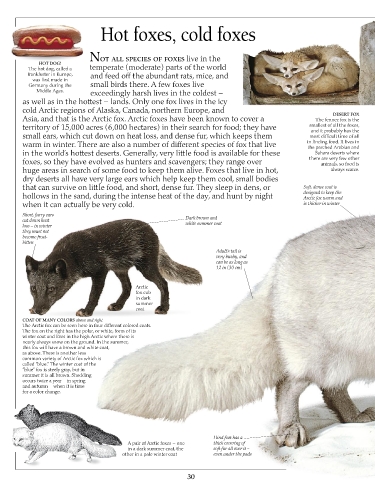
        COAT OF MANY COLORS above and right
        The Arctic fox can be seen here in four different colored coats.
        The fox on the right has the polar, or white, form of its
        winter coat and lives in the high Arctic where there is
        nearly always snow on the ground. In the summer,
        this fox will have a brown and white coat,
        as above. There is another less
        common variety of Arctic fox which is
        called “blue.” The winter coat of the
        “blue” fox is steely gray, but in
        summer it is all brown. Shedding
        occurs twice a year – in spring
        and autumn – when it is time
        for a color change.


                                                                       Hind foot has a
                                           A pair of Arctic foxes – one   thick covering of
                                           in a dark summer coat, the   soft fur all over it –
                                         other in a pale winter coat   even under the pads


                                                              30
                                            (c) 2011 Dorling Kindersley. All Rights Reserved.

