


Page 34 - Dog
P. 34
South American mix


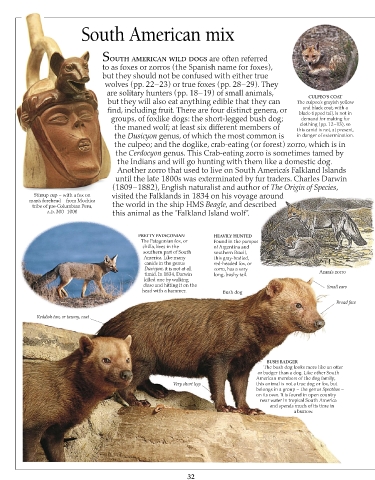
                                  South american wild dogs are often referred
                                  to as foxes or zorros (the Spanish name for foxes),
                                  but they should not be confused with either true
                                   wolves (pp. 22–23) or true foxes (pp. 28–29). They
                                    are solitary hunters (pp. 18–19) of small animals,                CULPEO’S COAT
                                    but they will also eat anything edible that they can          The culpeo’s grayish yellow
                                                                                                    and black coat, with a
                                    find, including fruit. There are four distinct genera, or      black-tipped tail, is not in
                                     groups, of foxlike dogs: the short-legged bush dog;           demand for making fur
                                                                                                   clothing (pp. 12–13), so
                                      the maned wolf; at least six different members of           this canid is not, at present,
                                      the Dusicyon genus, of which the most common is             in danger of extermination.
                                      the culpeo; and the doglike, crab-eating (or forest) zorro, which is in
                                       the Cerdocyon genus. This Crab-eating zorro is sometimes tamed by
                                       the Indians and will go hunting with them like a domestic dog.
                                       Another zorro that used to live on South America’s Falkland Islands
                                       until the late 1800s was exterminated by fur traders. Charles Darwin
                                      (1809–1882), English naturalist and author of The Origin of Species,
            Stirrup cup – with a fox on   visited the Falklands in 1834 on his voyage around
           man’s forehead – from Mochica
            tribe of pre-Columbian Peru,   the world in the ship HMS Beagle, and described
                a.d. 300–1000         this animal as the “Falkland Island wolf”.


                                              PRETTY PATAGONIAN        HEAVILY HUNTED
                                               The Patagonian fox, or   Found in the pampas
                                                chilla, lives in the   of Argentina and
                                                southern part of South   southern Brazil,
                                                America. Like many     this gray-bodied,
                                                canids in the genus    red-headed fox, or
                                                Dusicyon, it is not at all   zorro, has a very
                                                timid. In 1834, Darwin   Iong, bushy tail.               Azara’s zorro
                                                killed one by walking
                                                close and hitting it on the                                 Small ears
                                               head with a hammer.        Bush dog
                                                                                                               Broad face

             Reddish tan, or tawny, coat


                                                                                        BUSH BADGER
                                                                                       The bush dog looks more like an otter
                                                                                     or badger than a dog. Like other South
                                                                                     American members of the dog family,
                                                          Very short legs            this animal is not a true dog or fox, but
                                                                                     belongs in a group – the genus Speothos –
                                                                                     on its own. It is found in open country
                                                                                      near water in tropical South America
                                                                                         and spends much of its time in
                                                                                                 a burrow.


                                                              32
                                            (c) 2011 Dorling Kindersley. All Rights Reserved.

