


Page 36 - Dog
P. 36
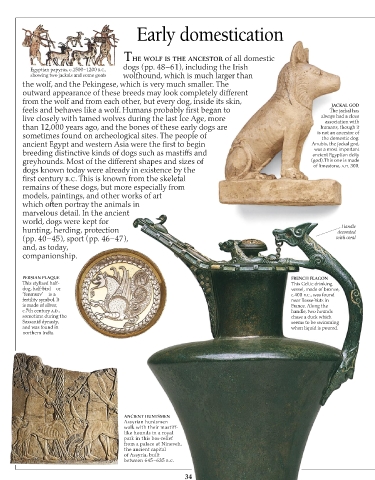
Early domestication


                                         The wolf is the ancestor of all domestic
                                         dogs (pp. 48–61), including the Irish
           Egyptian papyrus, c.1500–1200 b.c.,
           showing two jackals and some goats  wolfhound, which is much larger than
        the wolf, and the Pekingese, which is very much smaller. The
        outward appearance of these breeds may look completely different
        from the wolf and from each other, but every dog, inside its skin,
                                                                                                             JACKAL GOD
        feels and behaves like a wolf. Humans probably first began to                                        The jackal has
        live closely with tamed wolves during the last Ice Age, more                                      always had a close
                                                                                                           association with
        than 12,000 years ago, and the bones of these early dogs are                                      humans, though it
        sometimes found on archeological sites. The people of                                            is not an ancestor of
                                                                                                          the domestic dog.
        ancient Egypt and western Asia were the first to begin                                         Anubis, the jackal god,
                                                                                                        was a most important
        breeding distinctive kinds of dogs such as mastiffs and                                        ancient Egyptian deity
        greyhounds. Most of the different shapes and sizes of                                          (god).This one is made
        dogs known today were already in existence by the                                              of limestone, a.d. 300.
        first century b.c. This is known from the skeletal
        remains of these dogs, but more especially from
        models, paintings, and other works of art
        which often portray the animals in
        marvelous detail. In the ancient
        world, dogs were kept for
                                                                                                                 Handle
        hunting, herding, protection                                                                           decorated
        (pp. 40–45), sport (pp. 46–47),                                                                        with coral
        and, as today,
        companionship.


        PERSIAN PLAQUE                                                                          FRENCH FLAGON
        This stylized half-                                                                     This Celtic drinking
        dog, half-bird – or                                                                     vessel, made of bronze,
        “fenmurv” – is a                                                                        c.400 b.c., was found
        fertility symbol. It                                                                    near Basse-Yutz in
        is made of silver,                                                                      France. Along the
        c.7th century a.d.,                                                                     handle, two hounds
        sometime during the                                                                     chase a duck which
        Sassanid dynasty,                                                                       seems to be swimming
        and was found in                                                                        when liquid is poured.
        northern India.


                                          ANCIENT HUNTSMEN
                                          Assyrian huntsmen
                                          walk with their mastiff-
                                          like hounds in a royal
                                          park in this bas-relief
                                          from a palace at Nineveh,
                                          the ancient capital
                                          of Assyria, built
                                          between 645–635 b.c.

                                                             34
                                            (c) 2011 Dorling Kindersley. All Rights Reserved.

