


Page 100 - (DK) Smithsinian - Military History: The Definitive Visual Guide to the Objects of Warfare
P. 100
98    MONGOL ARMOR

         WMEN 500–1500  AND WEAPONS


            The Mongol warriors who swept through Central Asia, Eastern
            Europe, and China in the 13th century came from a nomadic tradition
            that valued mobility and the ability to strike from a distance. Mongol
            discipline was fierce—the army punished unlicensed plundering
            with death. They were organized into tümens (units of 10,000


            horseback, the Mongols were armed with composite
         AND BO  men) centered around an imperial guard. Fighting from
            bows that had a range of up to 655ft (200m), and a
            mixture of light arrows for greater range and heavier
            ones for penetrative power. Once an enemy had
            been softened up by multiple volleys of arrows,
            heavier cavalry armed with sabers moved in
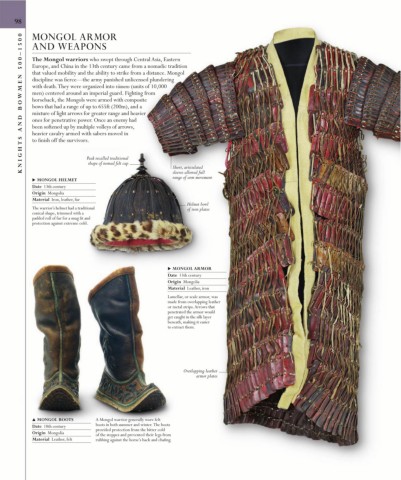
         KNIGHTS   to finish off the survivors. Peak recalled traditional


                                shape of nomad felt cap
                                                              Short, articulated
                                                              sleeves allowed full
                                                              range of arm movement
            ▶ MONGOL HELMET
            Date  13th century
            Origin  Mongolia
            Material  Iron, leather, fur
                                                                    Helmet bowl
            The warrior’s helmet had a traditional                  of iron plates
            conical shape, trimmed with a
            padded roll of fur for a snug fit and
            protection against extreme cold.


                                                             ▶ MONGOL ARMOR
                                                             Date  13th century
                                                             Origin  Mongolia
                                                             Material  Leather, iron
                                                             Lamellar, or scale armor, was
                                                             made from overlapping leather
                                                             or metal strips. Arrows that
                                                             penetrated the armor would
                                                             get caught in the silk layer
                                                             beneath, making it easier
                                                             to extract them.


                                                                  Overlapping leather
                                                                       armor plates


            ▲ MONGOL BOOTS         A Mongol warrior generally wore felt
            Date  18th century     boots in both summer and winter.  The boots
                                   provided protection from the bitter cold
            Origin  Mongolia
                                   of the steppes and prevented their legs from
            Material  Leather, felt  rubbing against the horse’s back and chafing.

