


Page 16 - (DK) Smithsinian - Military History: The Definitive Visual Guide to the Objects of Warfare
P. 16
14

         CE   KEY FIGURE
              RAMESSES II
         O 500  1279–1213bce

              One of the longest-reigning Egyptian
              pharaohs, Ramesses II led numerous
         ORDS   T  military campaigns, taking armies
              into Syria to the east, Libya to the
              west, and Nubia in the far south. His
              main rival was the Hittite emperor,
              Mutawallis. The climax of his second
              Syrian campaign was the Battle of
         AND SW  Kadesh in 1275bce, a clash with the
              Hittites that involved large chariot
              forces on both sides. Ramesses
              survived a devastating charge by the
              Hittite chariots to emerge victorious.

         TS
         CHARIO


              ▲ The head from a colossal statue
              of Ramesses II at the Temple of
              Abu Simbel, in southern Egypt.


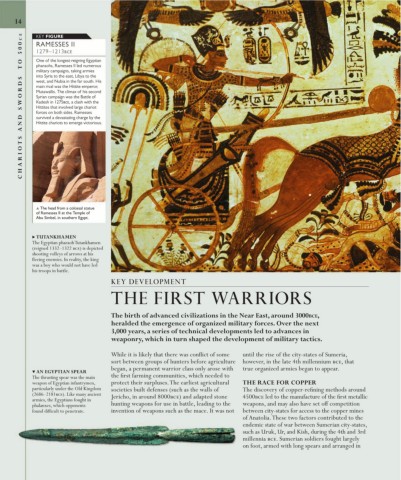
            ▶ TUTANKHAMEN
            The Egyptian pharaoh Tutankhamen
            (reigned 1332–1322 bce) is depicted
            shooting volleys of arrows at his
            fleeing enemies. In reality, the king
            was a boy who would not have led
            his troops in battle.
                                         KEY DEVELOPMENT
                                         THE FIRST WARRIORS


                                         The birth of advanced civilizations in the Near East, around 3000BCE,
                                         heralded the emergence of organized military forces. Over the next
                                         3,000 years, a series of technical developments led to advances in
                                         weaponry, which in turn shaped the development of military tactics.

                                         While it is likely that there was conflict of some   until the rise of the city-states of Sumeria,
                                         sort between groups of hunters before agriculture  however, in the late 4th millennium bce, that
                                         began, a permanent warrior class only arose with   true organized armies began to appear.
            ▼ AN EGYPTIAN SPEAR
            The thrusting spear was the main   the first farming communities, which needed to
            weapon of Egyptian infantrymen,   protect their surpluses. The earliest agricultural   THE RACE FOR COPPER
            particularly under the Old Kingdom   societies built defenses (such as the walls of   The discovery of copper-refining methods around
            (2686–2181bce). Like many ancient   Jericho, in around 8000bce) and adapted stone   4500bce led to the manufacture of the first metallic
            armies, the Egyptians fought in
            phalanxes, which opponents    hunting weapons for use in battle, leading to the   weapons, and may also have set off competition
            found difficult to penetrate.  invention of weapons such as the mace. It was not   between city-states for access to the copper mines
                                                                                        of Anatolia. These two factors contributed to the
                                                                                        endemic state of war between Sumerian city-states,
                                                                                        such as Uruk, Ur, and Kish, during the 4th and 3rd
                                                                                        millennia bce. Sumerian soldiers fought largely
                                                                                        on foot, armed with long spears and arranged in

