


Page 19 - (DK) Smithsinian - Military History: The Definitive Visual Guide to the Objects of Warfare
P. 19
17


                                                                                                                                        ST


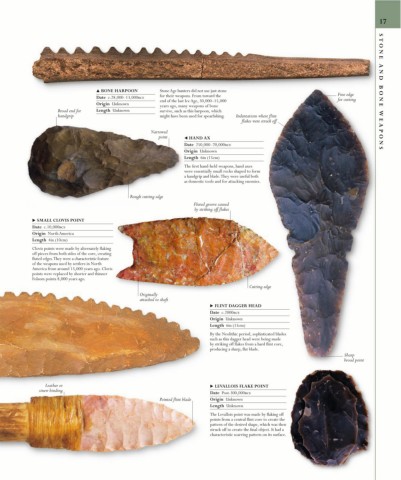
                                   ▲ BONE HARPOON         Stone Age hunters did not use just stone                                      ONE AND
                                   Date  c.28,000–13,000bce  for their weapons. From toward the                          Fine edge
                                                          end of the last Ice Age, 30,000–15,000                         for cutting
                                   Origin  Unknown
                                                          years ago, many weapons of bone
                     Broad end for   Length  Unknown      survive, such as this harpoon, which
                     handgrip                             might have been used for spearfishing.  Indentations where flint              BONE  WEAPONS
                                                                                       flakes were struck off
                                                       Narrowed
                                                         point     ◀ HAND AX
                                                                   Date  250,000–70,000bce
                                                                   Origin  Unknown
                                                                   Length  6in (15cm)
                                                                   The first hand-held weapons, hand axes
                                                                   were essentially small rocks shaped to form
                                                                   a handgrip and blade. They were useful both
                                                                   as domestic tools and for attacking enemies.

                                               Rough cutting edge
                                                                      Fluted groove caused
                                                                      by striking off flakes
            ▶ SMALL CLOVIS POINT
            Date  c.10,000bce
            Origin  North America
            Length  4in (10cm)
            Clovis points were made by alternately flaking
            off pieces from both sides of the core, creating
            fluted edges. They were a characteristic feature
            of the weapons used by settlers in North
            America from around 15,000 years ago. Clovis
            points were replaced by shorter and thinner
            Folsom points 8,000 years ago.
                                                                                          Cutting edge
                                                   Originally
                                                   attached to shaft
                                                                            ▶ FLINT DAGGER HEAD
                                                                            Date  c.2000bce
                                                                            Origin  Unknown
                                                                            Length  6in (15cm)
                                                                            By the Neolithic period, sophisticated blades
                                                                            such as this dagger head were being made
                                                                            by striking off flakes from a hard flint core,
                                                                            producing a sharp, flat blade.
                                                                                                                            Sharp
                                                                                                                            broad point


                 Leather or                                                 ▶ LEVALLOIS FLAKE POINT
               sinew binding
                                                                            Date  Post-300,000bce
                                                          Pointed flint blade  Origin  Unknown
                                                                            Length  Unknown
                                                                            The Levallois point was made by flaking off
                                                                            points from a central flint core to create the
                                                                            pattern of the desired shape, which was then
                                                                            struck off to create the final object. It had a
                                                                            characteristic scarring pattern on its surface.

