


Page 17 - (DK) Smithsinian - Military History: The Definitive Visual Guide to the Objects of Warfare
P. 17
15


                                                                                                                                        THE FIRST  W


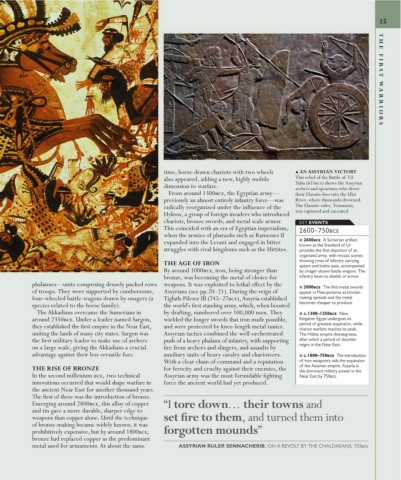
                                                           time, horse-drawn chariots with two wheels     ▲ AN ASSYRIAN  VICTORY        ARRIORS
                                                           also appeared, adding a new, highly mobile     This relief of the Battle of  Til
                                                           dimension to warfare.                          Tuba (655bce) shows the Assyrian
                                                                                                          archers and spearmen who drove
                                                             From around 1300bce, the Egyptian army—      their Elamite foes into the Ulai
                                                           previously an almost entirely infantry force—was   River, where thousands drowned.
                                                           radically reorganized under the influence of the   The Elamite ruler, Teumanni,
                                                           Hyksos, a group of foreign invaders who introduced   was captured and executed.
                                                           chariots, bronze swords, and metal scale armor.
                                                                                                            KEY EVENTS
                                                           This coincided with an era of Egyptian imperialism,   2600–750bce
                                                           when the armies of pharaohs such as Ramesses II
                                                           expanded into the Levant and engaged in bitter   ◼ 2600bce  A Sumerian artifact
                                                                                                            known as the Standard of Ur
                                                           struggles with rival kingdoms such as the Hittites.    provides the first depiction of an
                                                                                                            organized army, with mosaic scenes
                                                           THE AGE OF IRON                                  showing rows of infantry carrying
                                                                                                            spears and battle-axes, accompanied
                                                           By around 1000bce, iron, being stronger than     by onager-drawn battle-wagons. The
                                                           bronze, was becoming the metal of choice for     infantry have no shields or armor.
            phalanxes—units comprising densely packed rows  weapons. It was exploited to lethal effect by the   ◼ 2000bce  The first metal swords
            of troops.  They were supported by cumbersome,   Assyrians (see pp.20–21). During the reign of   appear in Mesopotamia as bronze-
            four-wheeled battle-wagons drawn by onagers (a   Tiglath-Pileser III (745–27bce), Assyria established   making spreads and the metal
            species related to the horse family).          the world’s first standing army, which, when boosted   becomes cheaper to produce.
              The Akkadians overcame the Sumerians in      by drafting, numbered over 100,000 men.  They    ◼ c.1300–1250bce  New
            around 2350bce. Under a leader named Sargon,   wielded the longer swords that iron made possible,   Kingdom Egypt undergoes its
            they established the first empire in the Near East,   and were protected by knee-length metal tunics.   period of greatest expansion, while
                                                                                                            chariot warfare reaches its peak.
            uniting the lands of many city states. Sargon was   Assyrian tactics combined the well-orchestrated   The Hittite empire disintegrates,
            the first military leader to make use of archers    push of a heavy phalanx of infantry, with supporting   after which a period of disorder
                                                                                                            reigns in the Near East.
            on a large scale, giving the Akkadians a crucial   fire from archers and slingers, and assaults by
            advantage against their less versatile foes.   auxiliary units of heavy cavalry and charioteers.   ◼ c.1000–750bce  The introduction
                                                           With a clear chain of command and a reputation    of iron weaponry aids the expansion
            THE RISE OF BRONZE                             for ferocity and cruelty against their enemies, the   of the Assyrian empire. Assyria is
                                                                                                            the dominant military power in the
            In the second millenium bce,  two technical    Assyrian army was the most formidable fighting   Near East by 750bce.
            innovations occurred that would shape warfare in   force the ancient world had yet produced.
            the ancient Near East for another thousand years.
            The first of these was the introduction of bronze.
            Emerging around 2800bce, this alloy of copper   “I tore down… their towns and
            and tin gave a more durable, sharper edge to
            weapons than copper alone. Until the technique    set fire to them, and turned them into
            of bronze-making became widely known, it was
            prohibitively expensive, but by around 1800bce,   forgotten mounds”
            bronze had replaced copper as the predominant
            metal used for armaments. At about the same          ASSYRIAN RULER SENNACHERIB, ON A REVOLT BY THE CHALDAEANS, 703bce

