


Page 20 - (DK) Smithsinian - Military History: The Definitive Visual Guide to the Objects of Warfare
P. 20
18

         CE  EARLY METAL WEAPONS
         O 500  The first organized armies, those of the Sumerians, are recorded in around 3000bce.

            While heavy war wagons were used, the Sumerians fought largely on foot and carried
            spears and shields. The development of the spoked wheel enabled much lighter, faster
         ORDS   T  vehicles to be built—open chariots, from which archers could shower enemies with   Double-edged blade  Gold scabbard
            arrows. Thus, chariot warfare came to dominate conflict in the Near East in the second
            millennium bce. But as advances in horse breeding produced more robust animals,
            mounted archers—even faster and more maneuverable than chariots—became
            more valuable to armies in the region, together with infantry foot soldiers
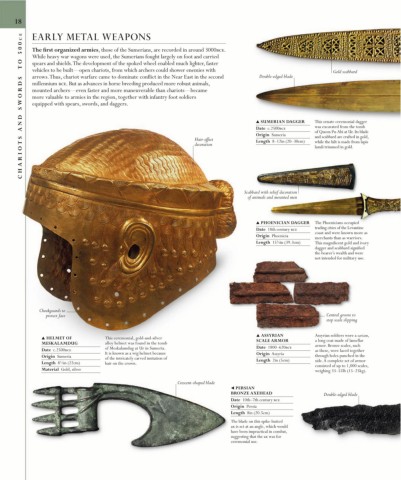
         AND SW  equipped with spears, swords, and daggers.                                 ▲ SUMERIAN DAGGER    This ornate ceremonial dagger


                                                                                                                 was excavated from the tomb
                                                                                            Origin  Sumeria
         TS                                                           Hair-effect           Date  c.2500bce      of Queen Pu-Abi at Ur. Its blade
                                                                                                                 and scabbard are crafted in gold,
                                                                                            Length  8–12in (20–30cm)
                                                                                                                 while the hilt is made from lapis
                                                                      decoration
                                                                                                                 lazuli trimmed in gold.
         CHARIO


                                                                                        Scabbard with relief decoration
                                                                                         of animals and mounted men


                                                                                            ▲ PHOENICIAN DAGGER  The Phoenicians occupied
                                                                                            Date  18th century bce  trading cities of the Levantine
                                                                                                                 coast and were known more as
                                                                                            Origin  Phoenicia
                                                                                                                 merchants than as warriors.
                                                                                            Length  15 ⁄4in (39.3cm)  This magnificent gold and ivory
                                                                                                    3
                                                                                                                 dagger and scabbard signified
                                                                                                                 the bearer’s wealth and were
                                                                                                                 not intended for military use.


               Cheekguards to
                 protect face                                                                                        Central groove to
                                                                                                                     stop scale slipping

                                                                                            ▲ ASSYRIAN           Assyrian soldiers wore a sariam,
                ▲ HELMET OF           This ceremonial, gold-and-silver                      SCALE ARMOR          a long coat made of lamellar
                MESKALAMDUG           alloy helmet was found in the tomb                                         armor. Bronze scales, such
                Date  c.2500bce       of Meskalamdug at Ur in Sumeria.                      Date  1800–620bce    as these, were laced together
                                      It is known as a wig helmet because                   Origin  Assyria
                Origin  Sumeria       of the intricately carved imitation of                                     through holes punched in the
                Length  8 ⁄2in (22cm)  hair on the crown.                                   Length  2in (5cm)    side. A complete set of armor
                      1
                                                                                                                 consisted of up to 1,000 scales,
                Material  Gold, silver                                                                           weighing 33–55lb (15–25kg).
                                                                Crescent-shaped blade
                                                                                   ◀ PERSIAN
                                                                                   BRONZE AXEHEAD                   Double-edged blade
                                                                                   Date  10th–7th century bce
                                                                                   Origin  Persia
                                                                                   Length  8in (20.5cm)
                                                                                   The blade on this spike-butted
                                                                                   ax is set at an angle, which would
                                                                                   have been impractical in combat,
                                                                                   suggesting that the ax was for
                                                                                   ceremonial use.

