


Page 18 - (DK) Smithsinian - Military History: The Definitive Visual Guide to the Objects of Warfare
P. 18
16

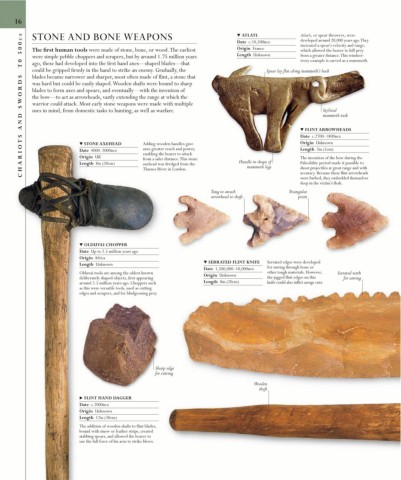
         CE  STONE AND BONE WEAPONS                                                  ▼ ATLATL               Atlatls, or spear throwers, were
                                                                                                            developed around 20,000 years ago. They
                                                                                     Date  c.10,500bce
         ORDS   T0 500  were simple pebble choppers and scrapers, but by around 1.75 million years   Length  Unknown  from a greater distance. This reindeer-
                                                                                                            increased a spear’s velocity and range,
                                                                                     Origin  France
            The first human tools were made of stone, bone, or wood. The earliest
                                                                                                            which allowed the bearer to kill prey
                                                                                                            ivory example is carved as a mammoth.
            ago, these had developed into the first hand axes—shaped blades—that
            could be gripped firmly in the hand to strike an enemy. Gradually, the
                                                                                                Spear lay flat along mammoth’s back
            blades became narrower and sharper, most often made of flint, a stone that
            was hard but could be easily shaped. Wooden shafts were bound to sharp
            blades to form axes and spears, and eventually—with the invention of
         AND SW  the bow—to act as arrowheads, vastly extending the range at which the                              Stylized
            warrior could attack. Most early stone weapons were made with multiple
            uses in mind, from domestic tasks to hunting, as well as warfare.
                                                                                                                    mammoth tusk


         TS                  ▼ STONE AXEHEAD        Adding wooden handles gave                              ▼ FLINT ARROWHEADS
                                                                                                            Date  c.2700–1800bce
                                                                                                            Origin  Unknown
         CHARIO              Date  4000–2000bce     enabling the bearer to attack     Handle in shape of    The invention of the bow during the
                                                    axes greater reach and power,
                                                                                                            Length  2in (5cm)
                             Origin  UK
                                                    from a safer distance. This stone
                                                                                                            Paleolithic period made it possible to
                             Length  8in (20cm)
                                                    axehead was dredged from the
                                                                                         mammoth legs
                                                                                                            shoot projectiles at great range and with
                                                    Thames River in London.
                                                                                                            accuracy. Because these flint arrowheads
                                                                                                            were barbed, they embedded themselves
                                                                                                            deep in the victim’s flesh.
                                                                            Tang to attach              Triangular
                                                                            arrowhead to shaft             point


                             ▼ OLDUVAI CHOPPER
                             Date  Up to 2.5 million years ago
                             Origin  Africa
                                                                          ▼ SERRATED FLINT KNIFE  Serrated edges were developed
                             Length  Unknown
                                                                          Date  1,500,000–10,000bce  for sawing through bone or
                             Olduvai tools are among the oldest known                           other tough materials. However,   Serrated teeth
                             deliberately shaped objects, first appearing   Origin  Unknown     the jagged flint edges on this   for sawing
                             around 2.5 million years ago. Choppers such   Length  8in (20cm)   knife could also inflict savage cuts.
                             as this were versatile tools, used as cutting
                             edges and scrapers, and for bludgeoning prey.


                                                        Sharp edge
                                                        for cutting
                                                                                            Wooden
                                                                                             shaft
                             ▶ FLINT HAND DAGGER
                             Date  c.2000bce
                             Origin  Unknown
                             Length  12in (30cm)
                             The addition of wooden shafts to flint blades,
                             bound with sinew or leather strips, created
                             stabbing spears, and allowed the bearer to
                             use the full force of his arm to strike blows.

