


Page 184 - (DK) Smithsinian - Military History: The Definitive Visual Guide to the Objects of Warfare
P. 184
182      KEY FIGURE                 KEY DEVELOPMENT

         ONET 1680–1815  NAPOLEON        ARMIES OF THE


              BONAPARTE
              1769–1821
              artillery officer who became the most  REVOLUTIONARY ERA
              Born in Corsica, Napoleon was an
              charismatic general in the French
              Revolutionary armies. In 1799, he
                                         with battles fought on an unprecedented scale. The military genius of French
              declaring himself Emperor in 1804.
              Defeated at Waterloo in 1815, he
                                         emperor Napoleon Bonaparte, meanwhile, whose empire grew out of the
         Y    seized power in a military coup,   The French Revolution of 1789 ushered in a new era of mass citizen armies,
              died a prisoner of the British.
         AND BA                          From 1792 to 1815, the French Revolutionary    for reconnaissance—the first ever instance of
                                         revolution, gave European warfare a fresh dynamism.
                                         Wars and the Napoleonic Wars kept Europe in an
                                                                                        aerial warfare. Elsewhere, the British adopted
                                         almost continuous state of warfare. There were
                                                                                        shrapnel shells as anti-personnel munitions,
         FLINTLOCK                       this period, some of which had an impact on the   However, the impact of these innovations was
                                                                                        and Congreve rockets as auxiliary artillery.
                                         a number of technological innovations during
                                         battlefield. The Chappe telegraph system, introduced  overshadowed by the changes that took place in
                                         by the French, in 1792 allowed messages to be sent  military organization and tactics.
                                         rapidly over long distances via a chain of visual
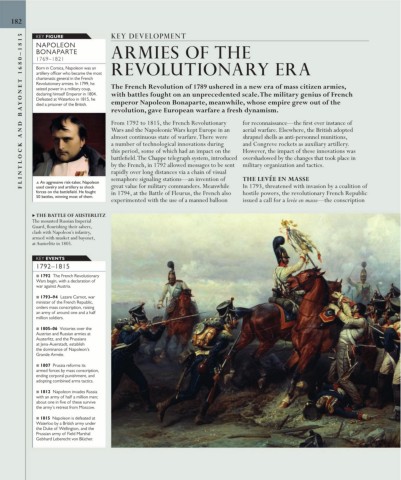
              ▲ An aggressive risk-taker, Napoleon
                                                                                        In 1793, threatened with invasion by a coalition of
                                         great value for military commanders. Meanwhile
              used cavalry and artillery as shock
                                                                                        hostile powers, the revolutionary French Republic
                                         in 1794, at the Battle of Fleurus, the French also
              forces on the battlefield. He fought    semaphore signaling stations—an invention of   THE LEVÉE EN MASSE
              50 battles, winning most of them.
                                         experimented with the use of a manned balloon    issued a call for a levée en masse—the conscription
            ▶ THE BATTLE OF AUSTERLITZ
            The mounted Russian Imperial
            Guard, flourishing their sabers,
            clash with Napoleon’s infantry,
            armed with musket and bayonet,
            at Austerlitz in 1805.


              KEY EVENTS
              1792–1815
              ◼ 1792  The French Revolutionary
              Wars begin, with a declaration of
              war against Austria.

              ◼ 1793–94  Lazare Carnot, war
              minister of the French Republic,
              orders mass conscription, raising
              an army of around one and a half
              million soldiers.

              ◼ 1805–06  Victories over the
              Austrian and Russian armies at
              Austerlitz, and the Prussians
              at Jena-Auerstadt, establish
              the dominance of Napoleon’s
              Grande Armée.

              ◼ 1807  Prussia reforms its
              armed forces by mass conscription,
              ending corporal punishment, and
              adopting combined arms tactics.

              ◼ 1812  Napoleon invades Russia
              with an army of half a million men;
              about one in five of these survive
              the army’s retreat from Moscow.

              ◼ 1815  Napoleon is defeated at
              Waterloo by a British army under
              the Duke of Wellington, and the
              Prussian army of Field Marshal
              Gebhard Leberecht von Blücher.

