


Page 186 - (DK) Smithsinian - Military History: The Definitive Visual Guide to the Objects of Warfare
P. 186
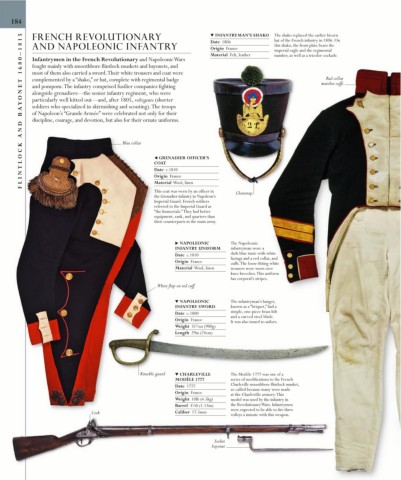
184    FRENCH REVOLUTIONARY                                            ▼ INFANTRYMAN’S SHAKO  The shako replaced the earlier bicorn

         ONET 1680–1815  AND NAPOLEONIC INFANTRY                            Origin  France         this shako, the front plate bears the
                                                                                                   hat of the French infantry in 1806. On
                                                                            Date  1806
                                                                                                   imperial eagle and the regimental
                                                                            Material  Felt, leather
                                                                                                   number, as well as a tricolor cockade.
            Infantrymen in the French Revolutionary and Napoleonic Wars
            fought mainly with smoothbore flintlock muskets and bayonets, and
            most of them also carried a sword. Their white trousers and coat were
                                                                                                                     Red collar
            complemented by a “shako,” or hat, complete with regimental badge
                                                                                                                    matches cuffs
            alongside grenadiers—the senior infantry regiment, who were
            particularly well kitted out—and, after 1805, voltigeurs (shorter
         Y  and pompom. The infantry comprised fusilier companies fighting
            soldiers who specialized in skirmishing and scouting). The troops
         AND BA  discipline, courage, and devotion, but also for their ornate uniforms.
            of Napoleon’s “Grande Armée” were celebrated not only for their


         FLINTLOCK                                      ◀ GRENADIER OFFICER’S
                                             Blue collar


                                                        COAT
                                                        Date  c.1810
                                                        Origin  France
                                                        Material  Wool, linen
                                                        This coat was worn by an officer in   Chinstrap
                                                        the Grenadier infantry in Napoleon’s
                                                        Imperial Guard. French soldiers
                                                        referred to the Imperial Guard as
                                                        “the Immortals.”  They had better
                                                        equipment, rank, and quarters than
                                                        their counterparts in the main army.


                                                               ▶ NAPOLEONIC        The Napoleonic
                                                               INFANTRY UNIFORM    infantryman wore a
                                                               Date  c.1810        dark blue tunic with white
                                                                                   facings and a red collar, and
                                                               Origin  France      cuffs. The loose-fitting white
                                                               Material  Wool, linen  trousers were worn over
                                                                                   knee breeches. This uniform
                                                                                   has corporal’s stripes.
                                                         White flap on red cuff

                                                               ▼ NAPOLEONIC        The infantryman’s hanger,
                                                               INFANTRY SWORD      known as a “briquet,” had a
                                                               Date  c.1800        simple, one-piece brass hilt
                                                                                   and a curved steel blade.
                                                               Origin  France      It was also issued to sailors.
                                                               Weight  31 ⁄4oz (900g)
                                                                       3
                                                               Length  29in (74cm)


                                                   Knuckle guard  ▼ CHARLEVILLE    The Modèle 1777 was one of a
                                                               MODÈLE 1777         series of modifications to the French
                                                               Date  1777          Charleville smoothbore flintlock musket,
                                                                                   so-called because many were made
                                                               Origin  France      at the Charleville armory. This
                                                               Weight  10lb (4.5kg)  model was used by the infantry in
                                                                     3
                                                               Barrel  3 ⁄4ft (1.13m)  the Revolutionary Wars. Infantrymen
                                                                                   were expected to be able to fire three
                                  Cock                         Caliber  17.5mm
                                                                                   volleys a minute with this weapon.


                                                                             Socket
                                                                             bayonet

