


Page 190 - (DK) Smithsinian - Military History: The Definitive Visual Guide to the Objects of Warfare
P. 190
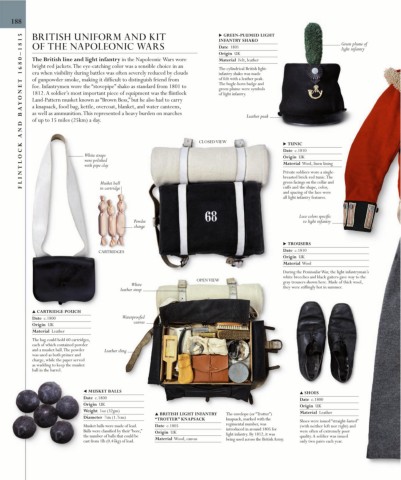
188    BRITISH UNIFORM AND KIT                                            ▶ GREEN-PLUMED LIGHT                        Green plume of

         ONET 1680–1815  OF THE NAPOLEONIC WARS                                Date  1801                                  light infantry
                                                                               INFANTRY SHAKO

                                                                               Origin  UK
            The British line and light infantry in the Napoleonic  Wars wore
                                                                               Material  Felt, leather
            bright red jackets. The eye-catching color was a sensible choice in an
                                                                               The cylindrical British light-
            era when visibility during battles was often severely reduced by clouds
                                                                               infantry shako was made
                                                                               of felt with a leather peak.
            of gunpowder smoke, making it difficult to distinguish friend from
                                                                               The bugle-horn badge and
            1812. A soldier’s most important piece of equipment was the flintlock
                                                                               of light infantry.
            Land-Pattern musket known as “Brown Bess,” but he also had to carry
         Y  foe. Infantrymen wore the “stovepipe” shako as standard from 1801 to    green plume were symbols
            a knapsack, food bag, kettle, overcoat, blanket, and water canteens,
         AND BA  of up to 15 miles (25km) a day.                        CLOSED VIEW      Leather peak
            as well as ammunition. This represented a heavy burden on marches


         FLINTLOCK             White straps                                                           ▶ TUNIC
                                                                                                      Date  c.1810
                                                                                                      Origin  UK
                               were polished
                                                                                                      Material  Wool, linen lining
                               with pipe clay
                                                                                                      Private soldiers wore a single-
                                                                                                      breasted brick-red tunic. The
                                                                                                      green facings on the collar and
                                     Musket ball
                                                                                                      cuffs and the shape, color,
                                     in cartridge
                                                                                                      and spacing of the lace were
                                                                                                      all light infantry features.

                                                                                                            Lace colors specific
                                                 Powder                                                      to light infantry
                                                 charge


                                                                                                      ▶ TROUSERS
                                    CARTRIDGES                                                        Date  c.1810
                                                                                                      Origin  UK
                                                                                                      Material  Wool
                                                                                                      During the Peninsular War, the light infantryman’s
                                                                                                      white breeches and black gaiters gave way to the
                                                                       OPEN VIEW
                                                White                                                 gray trousers shown here. Made of thick wool,
                                            leather strap                                             they were stiflingly hot in summer.


            ▲ CARTRIDGE POUCH
            Date  c.1800                    Waterproofed
                                                 canvas
            Origin  UK
            Material  Leather
            The bag could hold 60 cartridges,
            each of which contained powder
            and a musket ball. The powder   Leather sling
            was used as both primer and
            charge, while the paper served
            as wadding to keep the musket
            ball in the barrel.


                               ◀ MUSKET BALLS                                                               ▲ SHOES
                               Date  c.1800                                                                 Date  c.1800
                               Origin  UK                                                                   Origin  UK
                               Weight  1oz (32gm)                                                           Material  Leather
                                                        ▲ BRITISH LIGHT INFANTRY   The envelope (or “Trotter”)
                               Diameter   ⁄4in (1.7cm)  “TROTTER” KNAPSACK        knapsack, marked with the   Shoes were issued “straight-lasted”
                                      3
                               Musket balls were made of lead.   Date  c.1805     regimental number, was    (with neither left nor right) and
                               Balls were classified by their “bore,”   Origin  UK  introduced in around 1805 for   were often of extremely poor
                               the number of balls that could be                  light infantry. By 1812, it was   quality. A soldier was issued
                               cast from 1lb (0.45kg) of lead.   Material  Wood, canvas  being used across the British Army.   only two pairs each year.

