


Page 187 - (DK) Smithsinian - Military History: The Definitive Visual Guide to the Objects of Warfare
P. 187
185

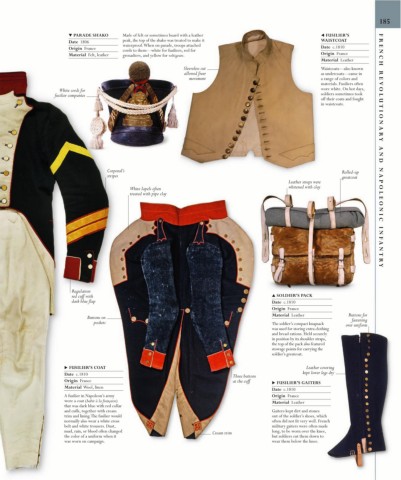
                         ▼ PARADE SHAKO      Made of felt or sometimes board with a leather                        ◀ FUSILIER’S
                         Date  1806          peak, the top of the shako was treated to make it                     WAISTCOAT
                                             waterproof. When on parade, troops attached
                         Origin  France      cords to them—white for fusiliers, red for                            Date  c.1810
                         Material  Felt, leather  grenadiers, and yellow for voltigeurs.                           Origin  France
                                                                                                                   Material  Leather    FRENCH REV
                                                                  Sleeveless cut                                   Waistcoats—also known
                                                                   allowed freer                                   as undercoats—came in
                                                                    movement                                       a range of colors and
                                                                                                                   materials. Fusiliers often
                                                                                                                   wore white. On hot days,
                      White cords for
                    fusilier companies                                                                             soldiers sometimes took
                                                                                                                   off their coats and fought
                                                                                                                   in waistcoats.       OLUTIONAR


                                       Corporal’s                                                                          Rolled-up    Y
                                       stripes                                                                             greatcoat
                                                                                                        Leather straps were
                                                                                                        whitened with clay
                                               White lapels often
                                               treated with pipe clay                                                                   AND NAPOLEONIC INF


                                                                                                                                        Y


                          Regulation                                                                                                    ANTR
                          red cuff with                                                           ▲ SOLDIER’S PACK
                          dark blue flap                                                          Date  c.1810
                                                                                                  Origin  France
                                                                                                  Material  Leather          Buttons for
                                Buttons on                                                                                    fastening
                                  pockets                                                         The soldier’s compact knapsack    over uniform
                                                                                                  was used for storing extra clothing
                                                                                                  and bread rations. Held securely
                                                                                                  in position by its shoulder straps,
                                                                                                  the top of the pack also featured
                                                                                                  stowage points for carrying the
                                                                                                  soldier’s greatcoat.

                        ▶ FUSILIER’S COAT                                                                     Leather covering
                        Date  c.1810                                                                         kept lower legs dry
                                                                                    Three buttons
                        Origin  France                                              at the cuff   ▶ FUSILIER’S GAITERS
                        Material  Wool, linen
                                                                                                  Date  c.1810
                        A fusilier in Napoleon’s army                                             Origin  France
                        wore a coat (habit à la française)                                        Material  Leather
                        that was dark blue with red collar
                        and cuffs, together with cream                                            Gaiters kept dirt and stones
                        trim and lining. The fusilier would                                       out of the soldier’s shoes, which
                        normally also wear a white cross                                          often did not fit very well. French
                        belt and white trousers. Dust,                                            military gaiters were often made
                        mud, rain, or blood often changed                    Cream trim           long, to be worn over the knee,
                        the color of a uniform when it                                            but soldiers cut them down to
                        was worn on campaign.                                                     wear them below the knee.

