


Page 193 - (DK) Smithsinian - Military History: The Definitive Visual Guide to the Objects of Warfare
P. 193
191


                                                                         Wooden
                                                                           stock


                                                Ramrod for
                                              loading bullets
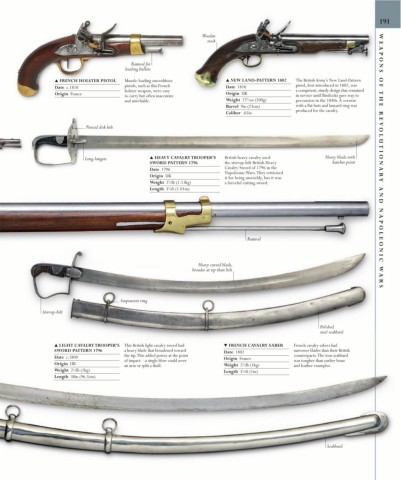
                    ▲ FRENCH HOLSTER PISTOL  Muzzle-loading smoothbore            ▲ NEW LAND-PATTERN 1802  The British Army’s New Land-Pattern   WEAPONS OF  THE REV
                    Date  c.1810             pistols, such as this French         Date  1810              pistol, first introduced in 1802, was
                                             holster weapon, were easy                                    a competent, sturdy design that remained
                    Origin  France                                                Origin  UK
                                             to carry but often inaccurate                                in service until flintlocks gave way to
                                                                                         1
                                             and unreliable.                      Weight  17 ⁄2oz (500g)  percussion in the 1840s. A version
                                                                                  Barrel  9in (23cm)      with a flat butt and lanyard ring was
                                                                                                          produced for the cavalry.
                                                                                  Caliber  .65in
                                Pierced disk hilt


                               Long langets           ▲ HEAVY CAVALRY TROOPER’S   British heavy cavalry used         Heavy blade with   OLUTIONAR
                                                      SWORD PATTERN 1796         the stirrup-hilt British Heavy         hatchet point
                                                      Date  1796                 Cavalry Sword of 1796 in the
                                                                                 Napoleonic Wars. They criticized
                                                      Origin  UK                 it for being unwieldy, but it was
                                                      Weight  2 ⁄2lb (1.13kg)    a forceful cutting sword.                              Y
                                                             1
                                                             1
                                                      Length  3 ⁄4ft (1.01m)


                                                                                         Ramrod                                         AND NAPOLEONIC  W


                                                                        Heavy curved blade,
                                                                     broader at tip than hilt                                           ARS


                                            Suspension ring

                Stirrup-hilt

                                                                                                                   Polished
                                                                                                                   steel scabbard

                    ▲ LIGHT CAVALRY TROOPER’S  This British light cavalry sword had    ▼ FRENCH CAVALRY SABER  French cavalry sabers had
                    SWORD PATTERN 1796       a heavy blade that broadened toward    Date  1802            narrower blades than their British
                    Date  c.1800             the tip. This added power at the point    Origin  France     counterparts. The iron scabbard
                                             of impact—a single blow could sever                          was tougher than earlier brass
                    Origin  UK               an arm or split a skull.            Weight  2 ⁄4lb (1kg)     and leather examples.
                                                                                       1
                           1
                    Weight  2 ⁄4lb (1kg)                                         Length  3 ⁄4ft (1m)
                                                                                       1
                    Length  38in (96.5cm)


                                                                                                                      Scabbard

