


Page 194 - (DK) Smithsinian - Military History: The Definitive Visual Guide to the Objects of Warfare
P. 194
192    FOREFATHER OF THE MODERN RIFLE                                FULL VIEW Stock              Flintlock mechanism  Fixed fore sight

         ONET 1680–1815  BAKER RIFLE                                      ▲ BAKER RIFLE        Leather sling          Sword bayonet Ramrod


                                                                                                     Trigger
                                                                                Patchbox
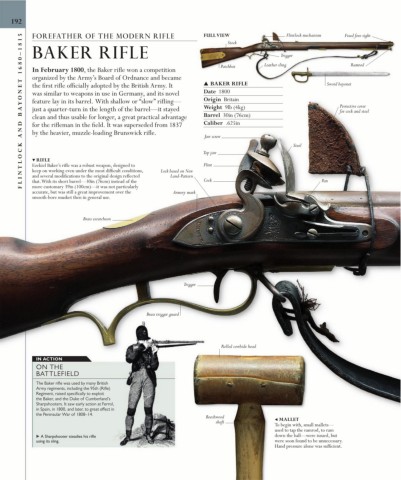
            In February 1800, the Baker rifle won a competition
            organized by the Army’s Board of Ordnance and became
            the first rifle officially adopted by the British Army. It

                                                                          Origin  Britain
            feature lay in its barrel. With shallow or “slow” rifling—
         Y  was similar to weapons in use in Germany, and its novel       Date  1800                                      Protective cover
                                                                          Weight  9lb (4kg)
            just a quarter-turn in the length of the barrel—it stayed
         AND BA  clean and thus usable for longer, a great practical advantage    Barrel  30in (76cm)
                                                                                                                          for cock and steel
                                                                          Caliber  .625in
            for the rifleman in the field. It was superseded from 1837
            by the heavier, muzzle-loading Brunswick rifle.
                                                                          Jaw screw
         FLINTLOCK   ▼ RIFLE                              Lock based on New   Top jaw                     Steel


            Ezekiel Baker’s rifle was a robust weapon, designed to
                                                                          Flint
            keep on working even under the most difficult conditions,
            and several modifications to the original design reflected
                                                              Land-Pattern
            that. With its short barrel—30in (76cm) instead of the
            more customary 39in (100cm)—it was not particularly
            accurate, but was still a great improvement over the   Armory mark  Cock                                Pan
            smooth-bore musket then in general use.


                               Brass escutcheon


                                                                  Trigger


                                                     Brass trigger guard


                                                                                Rolled cowhide head

              IN ACTION
              ON THE
              BATTLEFIELD

              The Baker rifle was used by many British
              Army regiments, including the 95th (Rifle)
              Regiment, raised specifically to exploit
              the Baker, and the Duke of Cumberland’s
              Sharpshooters. It saw early action at Ferrol,
              in Spain, in 1800, and later, to great effect in
              the Peninsular War of 1808–14.
                                                                          Beechwood                ◀ MALLET
                                                                              shaft
                                                                                                   To begin with, small mallets—
                                                                                                   used to tap the ramrod, to ram
              ▶ A Sharpshooter steadies his rifle                                                  down the ball—were issued, but
              using its sling.                                                                     were soon found to be unnecessary.
                                                                                                   Hand pressure alone was sufficient.

