


Page 197 - (DK) Smithsinian - Military History: The Definitive Visual Guide to the Objects of Warfare
P. 197
195

                                                               CAVALRY AND THE INFANTRY SQUARE
                                                               THE BATTLE                                                               THE BA


                                                               OF WATERLOO


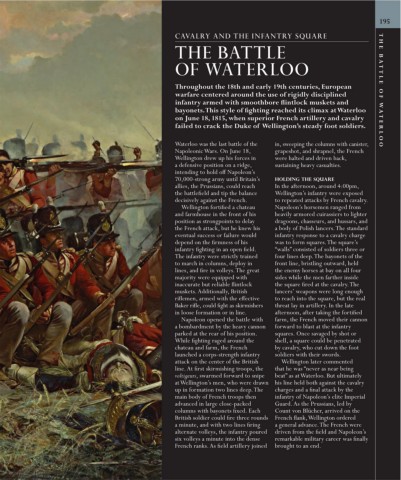
                                                               Throughout the 18th and early 19th centuries, European                   TTLE OF  W
                                                               warfare centered around the use of rigidly disciplined
                                                               infantry armed with smoothbore flintlock muskets and
                                                               bayonets. This style of fighting reached its climax at Waterloo          A
                                                               on June 18, 1815, when superior French artillery and cavalry
                                                               failed to crack the Duke of  Wellington’s steady foot soldiers.          TERLOO


                                                               Waterloo was the last battle of the   in, sweeping the columns with canister,
                                                               Napoleonic Wars. On June 18,        grapeshot, and shrapnel, the French
                                                               Wellington drew up his forces in    were halted and driven back,
                                                               a defensive position on a ridge,    sustaining heavy casualties.
                                                               intending to hold off Napoleon’s
                                                               70,000-strong army until Britain’s   HOLDING THE SQUARE
                                                               allies, the Prussians, could reach    In the afternoon, around 4:00pm,
                                                               the battlefield and tip the balance   Wellington’s infantry were exposed
                                                               decisively against the French.      to repeated attacks by French cavalry.
                                                                  Wellington fortified a chateau    Napoleon’s horsemen ranged from
                                                               and farmhouse in the front of his   heavily armored cuirassiers to lighter
                                                               position as strongpoints to delay    dragoons, chasseurs, and hussars, and
                                                               the French attack, but he knew his   a body of Polish lancers. The standard
                                                               eventual success or failure would   infantry response to a cavalry charge
                                                               depend on the firmness of his       was to form squares. The square’s
                                                               infantry fighting in an open field.    “walls” consisted of soldiers three or
                                                               The infantry were strictly trained    four lines deep. The bayonets of the
                                                               to march in columns, deploy in      front line, bristling outward, held
                                                               lines, and fire in volleys. The great   the enemy horses at bay on all four
                                                               majority were equipped with         sides while the men farther inside
                                                               inaccurate but reliable flintlock   the square fired at the cavalry. The
                                                               muskets. Additionally, British      lancers’ weapons were long enough
                                                               riflemen, armed with the effective   to reach into the square, but the real
                                                               Baker rifle, could fight as skirmishers   threat lay in artillery. In the late
                                                               in loose formation or in line.      afternoon, after taking the fortified
                                                                  Napoleon opened the battle with    farm, the French moved their cannon
                                                               a bombardment by the heavy cannon   forward to blast at the infantry
                                                               parked at the rear of his position.   squares. Once savaged by shot or
                                                               While fighting raged around the     shell, a square could be penetrated
                                                               chateau and farm, the French        by cavalry, who cut down the foot
                                                               launched a corps-strength infantry   soldiers with their swords.
                                                               attack on the center of the British   Wellington later commented
                                                               line. At first skirmishing troops, the   that he was “never as near being
                                                               voltigeurs, swarmed forward to snipe   beat” as at Waterloo. But ultimately
                                                               at Wellington’s men, who were drawn  his line held both against the cavalry
                                                               up in formation two lines deep. The   charges and a final attack by the
                                                               main body of French troops then     infantry of Napoleon’s elite Imperial
                                                               advanced in large close-packed      Guard. As the Prussians, led by
                                                               columns with bayonets fixed. Each   Count von Blücher, arrived on the
                                                               British soldier could fire three rounds  French flank, Wellington ordered
                                                               a minute, and with two lines firing   a general advance. The French were
                                                               alternate volleys, the infantry poured  driven from the field and Napoleon’s
                                                               six volleys a minute into the dense   remarkable military career was finally
                                                               French ranks. As field artillery joined  brought to an end.

