


Page 198 - (DK) Smithsinian - Military History: The Definitive Visual Guide to the Objects of Warfare
P. 198
196      KEY FIGURE

         ONET 1680–1815  1758–1805
              HORATIO NELSON


              Nelson was a fearless and often
              insubordinate British admiral who
              was brought to prominence by a bold
              maneuver at Cape St. Vincent, in
              1797. His victories at the Nile (1798),
              (1805) made him a national hero.
         Y    Copenhagen (1801), and Trafalgar
         AND BA


         FLINTLOCK


                                         KEY DEVELOPMENT
                                         NAVAL BATTLES IN


                                         THE AGE OF SAIL


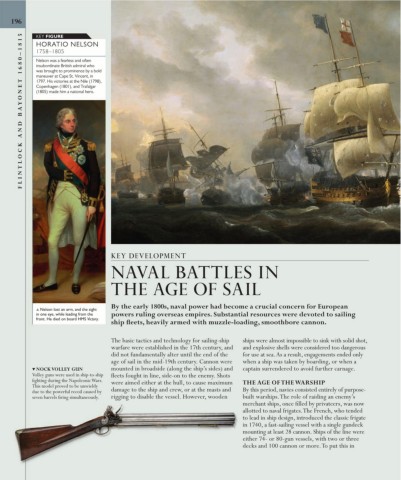
                                         By the early 1800s, naval power had become a crucial concern for European
              ▲ Nelson lost an arm, and the sight
              in one eye, while leading from the    powers ruling overseas empires. Substantial resources were devoted to sailing
              front. He died on board HMS Victory.
                                         ship fleets, heavily armed with muzzle-loading, smoothbore cannon.

                                         The basic tactics and technology for sailing-ship   ships were almost impossible to sink with solid shot,
                                         warfare were established in the 17th century, and   and explosive shells were considered too dangerous
                                         did not fundamentally alter until the end of the    for use at sea. As a result, engagements ended only
                                         age of sail in the mid-19th century. Cannon were   when a ship was taken by boarding, or when a
            ▼ NOCK VOLLEY GUN            mounted in broadside (along the ship’s sides) and   captain surrendered to avoid further carnage.
            Volley guns were used in ship-to-ship   fleets fought in line, side-on to the enemy. Shots
            fighting during the Napoleonic Wars.   were aimed either at the hull, to cause maximum   THE AGE OF THE WARSHIP
            This model proved to be unwieldy
            due to the powerful recoil caused by   damage to the ship and crew, or at the masts and   By this period, navies consisted entirely of purpose-
            seven barrels firing simultaneously.  rigging to disable the vessel. However, wooden   built warships. The role of raiding an enemy’s
                                                                                        merchant ships, once filled by privateers, was now
                                                                                        allotted to naval frigates. The French, who tended
                                                                                        to lead in ship design, introduced the classic frigate
                                                                                        in 1740, a fast-sailing vessel with a single gundeck
                                                                                        mounting at least 28 cannon. Ships of the line were
                                                                                        either 74- or 80-gun vessels, with two or three
                                                                                        decks and 100 cannon or more. To put this in

