


Page 205 - (DK) Smithsinian - Military History: The Definitive Visual Guide to the Objects of Warfare
P. 205
203

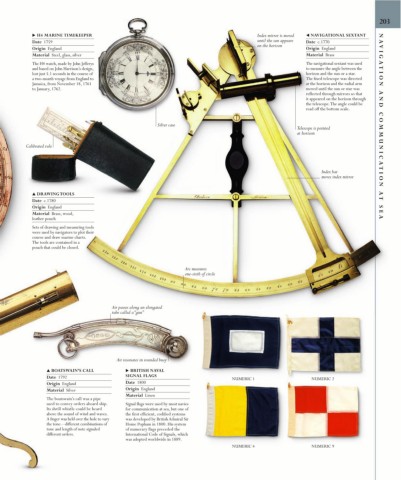
            ▶ H4 MARINE  TIMEKEEPER                                                          Index mirror is moved   ◀ NAVIGATIONAL SEXTANT
            Date  1759                                                                       until the sun appears   Date  c.1770
                                                                                             on the horizon
            Origin  England                                                                                   Origin  England           NA VIGA
            Material  Steel, glass, silver                                                                    Material  Brass
            The H4 watch, made by John Jefferys                                                               The navigational sextant was used
            and based on John Harrison’s design,                                                              to measure the angle between the
            lost just 5.1 seconds in the course of                                                            horizon and the sun or a star.
            a two-month voyage from England to                                                                The fixed telescope was directed
            Jamaica, from November 18, 1761                                                                   at the horizon and the radial arm
            to January, 1762.                                                                                 moved until the sun or star was   TION AND
                                                                                                              reflected through mirrors so that
                                                                                                              it appeared on the horizon through
                                                                                                              the telescope. The angle could be
                                                                                                              read off the bottom scale.

                                                         Silver case
                                                                                                           Telescope is pointed
                                                                                                           at horizon                   COMMUNICA

          Calibrated rule


                                                                                                                    Index bar
                                                                                                                    moves index mirror  TION A


            ▲ DRAWING TOOLS
            Date  c.1780                                                                                                                T
            Origin  England
            Material  Brass, wood,                                                                                                      SEA
            leather pouch
            Sets of drawing and measuring tools
            were used by navigators to plot their
            course and draw marine charts.
            The tools are contained in a
            pouch that could be closed.


                                                                   Arc measures
                                                                   one-sixth of circle


                                         Air passes along an elongated
                                         tube called a “gun”


                                          Air resonates in rounded buoy
                 ▲ BOATSWAIN’S CALL           ▶ BRITISH NAVAL
                 Date  1792                   SIGNAL FLAGS                          NUMERIC 1                   NUMERIC 2
                 Origin  England              Date  1800
                 Material  Silver             Origin  England
                                              Material  Linen
                 The boatswain’s call was a pipe
                 used to convey orders aboard ship.   Signal flags were used by most navies
                 Its shrill whistle could be heard   for communication at sea, but one of
                 above the sound of wind and waves.    the first efficient, codified systems
                 A finger was held over the hole to vary   was developed by British Admiral Sir
                 the tone—different combinations of   Home Popham in 1800. His system
                 tone and length of note signaled   of numerary flags preceded the
                 different orders.            International Code of Signals, which
                                              was adopted worldwide in 1889.
                                                                                    NUMERIC 4                   NUMERIC 9

