


Page 201 - (DK) Smithsinian - Military History: The Definitive Visual Guide to the Objects of Warfare
P. 201
199

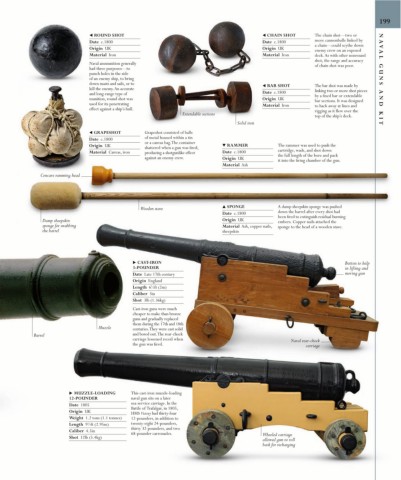
                                 ◀ ROUND SHOT                                                  ◀ CHAIN SHOT      The chain shot—two or
                                 Date  c.1800                                                  Date  c.1800      more cannonballs linked by
                                                                                                                 a chain—could scythe down
                                 Origin  UK                                                    Origin  UK        enemy crew on an exposed
                                 Material  Iron                                                Material  Iron    deck. As with other nonround
                                                                                                                 shot, the range and accuracy   NA V AL GUNS
                                 Naval ammunition generally                                                      of chain shot was poor.
                                 had three purposes—to
                                 punch holes in the side
                                 of an enemy ship, to bring
                                 down masts and sails, or to                                   ◀ BAR SHOT        The bar shot was made by
                                 kill the enemy. An accurate                                                     linking two or more shot pieces
                                 and long-range type of                                        Date  c.1800      by a fixed bar or extendable
                                 munition, round shot was                                      Origin  UK        bar sections. It was designed
                                 used for its penetrating                                      Material  Iron    to hack away at lines and
                                 effect against a ship’s hull.                                                   rigging as it flew over the    AND KIT
                                                                  Extendable sections
                                                                                                                 top of the ship’s deck.
                                                                                      Solid iron
                                 ◀ GRAPESHOT         Grapeshot consisted of balls
                                 Date  c.1800        of metal housed within a tin
                                                     or a canvas bag. The container
                                 Origin  UK          shattered when a gun was fired,   ▼ RAMMER     The rammer was used to push the
                                 Material  Canvas, iron  producing a shotgunlike effect   Date  c.1800  cartridge, wads, and shot down
                                                     against an enemy crew.     Origin  UK          the full length of the bore and pack
                                                                                                    it into the firing chamber of the gun.
                                                                                Material  Ash
               Concave ramming head


                                                                                ▲ SPONGE            A damp sheepskin sponge was pushed
                                                   Wooden stave
                                                                                Date  c.1800        down the barrel after every shot had
                                                                                                    been fired to extinguish residual burning
                Damp sheepskin                                                  Origin  UK          embers. Copper nails attached the
                sponge for swabbing                                             Material  Ash, copper nails,   sponge to the head of a wooden stave.
                the barrel                                                      sheepskin


                                                ▶ CAST-IRON                                                                 Button to help
                                                3-POUNDER                                                                   in lifting and
                                                Date  Late 17th century                                                     moving gun
                                                Origin  England
                                                       1
                                                Length  6 ⁄2ft (2m)
                                                Caliber  3in
                                                Shot  3lb (1.36kg)
                                                Cast-iron guns were much
                                                cheaper to make than bronze
                                                guns and gradually replaced
                                                them during the 17th and 18th
                                    Muzzle      centuries. They were cast solid
             Barrel                             and bored out. The rear-chock
                                                carriage lessened recoil when                            Naval rear-chock
                                                the gun was fired.
                                                                                                              carriage


                          ▶ MUZZLE-LOADING      This cast-iron muzzle-loading
                          12-POUNDER            naval gun sits on a later
                          Date  1805            sea-service carriage. In the
                                                Battle of  Trafalgar, in 1805,
                          Origin  UK            HMS Victory had thirty-four
                          Weight  1.2 tons (1.1 tonnes)  12-pounders, in addition to
                                1
                          Length  9 ⁄2ft (2.95m)  twenty-eight 24-pounders,
                                                thirty 32-pounders, and two
                          Caliber  4.5in
                                                68-pounder carronades.                         Wheeled carriage
                          Shot  12lb (5.4kg)
                                                                                               allowed gun to roll
                                                                                               back for recharging

