


Page 200 - (DK) Smithsinian - Military History: The Definitive Visual Guide to the Objects of Warfare
P. 200
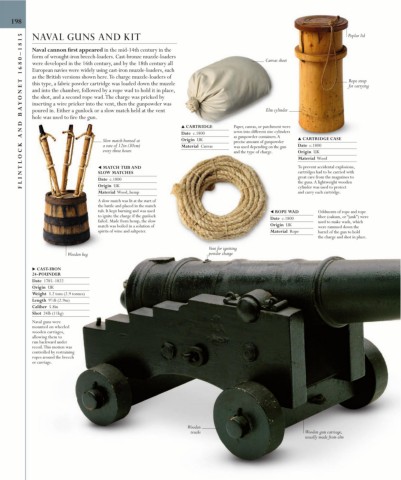
198    NAVAL GUNS AND KIT                                                                                               Poplar lid

         ONET 1680–1815  Naval cannon first appeared in the mid-14th century in the             Canvas sheet                 Rope strap


            form of wrought-iron breech-loaders. Cast-bronze muzzle-loaders
            were developed in the 16th century, and by the 18th century all
            European navies were widely using cast-iron muzzle-loaders, such
            as the British versions shown here. To charge muzzle-loaders of
            this type, a fabric powder cartridge was loaded down the muzzle

            the shot, and a second rope wad. The charge was pricked by
            inserting a wire pricker into the vent, then the gunpowder was
         Y  and into the chamber, followed by a rope wad to hold it in place,                   Elm cylinder                 for carrying
         AND BA  hole was used to fire the gun.  Slow match burned at    ▲ CARTRIDGE  Paper, canvas, or parchment were   ▲ CARTRIDGE CASE
            poured in. Either a gunlock or a slow match held at the vent


                                                                                    sewn into different size cylinders
                                                                  Date  c.1800
                                                                                    as gunpowder containers. A
                                                                  Origin  UK
         FLINTLOCK                  ◀ MATCH  TUB AND              Material  Canvas  was used depending on the gun   Date  c.1800
                                                                                    precise amount of gunpowder
                                      a rate of 12in (30cm)
                                      every three hours
                                                                                    and the type of charge.
                                                                                                           Origin  UK
                                                                                                           Material  Wood
                                                                                                           To prevent accidental explosions,
                                                                                                           cartridges had to be carried with
                                    SLOW MATCHES
                                                                                                           great care from the magazines to
                                    Date  c.1800
                                    Origin  UK
                                                                                                           cylinder was used to protect
                                                                                                           and carry each cartridge.
                                    Material  Wood, hemp                                                   the guns. A lightweight wooden
                                    A slow match was lit at the start of
                                    the battle and placed in the match
                                    tub. It kept burning and was used                            ◀ ROPE  WAD      Oddments of rope and rope
                                    to ignite the charge if the gunlock                          Date  c.1800     fiber (oakum, or “junk”) were
                                    failed. Made from hemp, the slow                                              used to make wads, which
                                    match was boiled in a solution of                            Origin  UK       were rammed down the
                                    spirits of wine and saltpeter.                               Material  Rope   barrel of the gun to hold
                                                                                                                  the charge and shot in place.
                                                                           Vent for igniting
                         Wooden keg                                        powder charge
            ▶ CAST-IRON
            24-POUNDER
            Date  1785–1822
            Origin  UK
            Weight  3.2 tons (2.9 tonnes)
            Length  9 ⁄2ft (2.9m)
                   1
            Caliber  5.8in
            Shot  24lb (11kg)
            Naval guns were
            mounted on wheeled
            wooden carriages,
            allowing them to
            run backward under
            recoil. This motion was
            controlled by restraining
            ropes around the breech
            or carriage.


                                                                    Wooden
                                                                     trucks                                   Wooden gun carriage,
                                                                                                              usually made from elm

