


Page 204 - (DK) Smithsinian - Military History: The Definitive Visual Guide to the Objects of Warfare
P. 204
202    NAVIGATION AND                                                                                             Suspension ring

         ONET 1680–1815  COMMUNICATION AT SEA


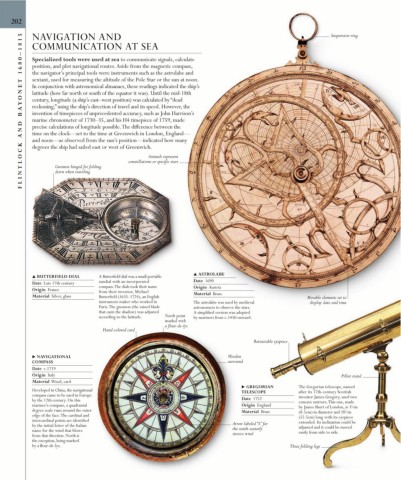
            Specialized tools were used at sea to communicate signals, calculate
            position, and plot navigational routes. Aside from the magnetic compass,
            the navigator’s principal tools were instruments such as the astrolabe and
            sextant, used for measuring the altitude of the Pole Star or the sun at noon.

            latitude (how far north or south of the equator it was). Until the mid-18th
            century, longitude (a ship’s east–west position) was calculated by “dead
         Y  In conjunction with astronomical almanacs, these readings indicated the ship’s
            reckoning,” using the ship’s direction of travel and its speed. However, the
         AND BA  marine chronometer of 1730–35, and his H4 timepiece of 1759, made
            invention of timepieces of unprecedented accuracy, such as John Harrison’s
            precise calculations of longitude possible. The difference between the
            time on the clock—set to the time at Greenwich in London, England—
            and noon—as observed from the sun’s position—indicated how many
         FLINTLOCK   degrees the ship had sailed east or west of Greenwich.

                                                      Animals represent
                                               constellations or specific stars
                     Gnomon hinged for folding
                     down when traveling


                                                                      ▲ ASTROLABE
            ▲ BUTTERFIELD DIAL      A Butterfield dial was a small portable
            Date  Late 17th century  sundial with an incorporated     Date  1690
                                    compass. The dials took their name   Origin  Austria
            Origin  France
                                    from their inventor, Michael
            Material  Silver, glass  Butterfield (1635–1724), an English   Material  Brass                    Movable elements set to
                                    instrument-maker who worked in    The astrolabe was used by medieval       display date and time
                                    Paris. The gnomon (the raised blade   astronomers to observe the stars.
                                    that casts the shadow) was adjusted   A simplified version was adopted
                                    according to the latitude.  North point   by mariners from c.1450 onward.
                                                            marked with
                                                            a fleur-de-lys
                                      Hand-colored card

                                                                                           Retractable eyepiece

            ▶ NAVIGATIONAL                                                        Wooden
            COMPASS                                                               surround
            Date  c.1719
            Origin  Italy                                                                                                  Pillar stand
            Material  Wood, card
                                                                                       ▶ GREGORIAN         The Gregorian telescope, named
            Developed in China, the navigational                                       TELESCOPE           after its 17th-century Scottish
            compass came to be used in Europe                                                              inventor James Gregory, used two
            by the 12th century. On this                                               Date  1752          concave mirrors. This one, made
            mariner’s compass, a quadrantal                                            Origin  England     by James Short of London, is 3 ⁄4in
                                                                                                                              1
            degree scale runs around the outer                                         Material  Brass     (8.5cm) in diameter and 20 ⁄2in
                                                                                                                            1
            edge of the face. The cardinal and                                                             (52.5cm) long with its eyepiece
            intercardinal points are identified                                                            extended. Its inclination could be
            by the initial letter of the Italian                                    Arrow labeled “S”  for   adjusted and it could be moved
            name for the wind that blows                                            the south-easterly     easily from side to side.
            from that direction. North is                                           sirocco wind
            the exception, being marked
            by a fleur-de-lys.                                                                          Three folding legs

