


Page 22 - (DK) Smithsinian - Military History: The Definitive Visual Guide to the Objects of Warfare
P. 22
20

         CE  ANCIENT SIEGE WARFARE
         O 500  THE SIEGE


            OF LACHISH
         ORDS   T  By the 8th century BCE, the Assyrian empire had an army of


            unprecedented size and efficiency. Its assault on the fortified
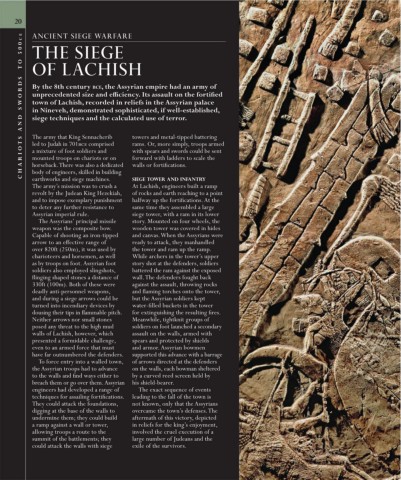
         AND SW  town of Lachish, recorded in reliefs in the Assyrian palace
            in Nineveh, demonstrated sophisticated, if well-established,
            siege techniques and the calculated use of terror.


         TS   The army that King Sennacherib    towers and metal-tipped battering
                                                rams. Or, more simply, troops armed
            led to Judah in 701bce comprised
         CHARIO  mounted troops on chariots or on   forward with ladders to scale the
                                                with spears and swords could be sent
            a mixture of foot soldiers and
                                                walls or fortifications.
            horseback. There was also a dedicated
            body of engineers, skilled in building
            earthworks and siege machines.
                                                At Lachish, engineers built a ramp
            The army’s mission was to crush a   SIEGE TOWER AND INFANTRY
            revolt by the Judean King Hezekiah,   of rocks and earth reaching to a point
            and to impose exemplary punishment   halfway up the fortifications. At the
            to deter any further resistance to   same time they assembled a large
            Assyrian imperial rule.             siege tower, with a ram in its lower
               The Assyrians’ principal missile   story. Mounted on four wheels, the
            weapon was the composite bow.       wooden tower was covered in hides
            Capable of shooting an iron-tipped   and canvas. When the Assyrians were
            arrow to an effective range of      ready to attack, they manhandled
            over 820ft (250m), it was used by   the tower and ram up the ramp.
            charioteers and horsemen, as well    While archers in the tower’s upper
            as by troops on foot. Assyrian foot   story shot at the defenders, soldiers
            soldiers also employed slingshots,   battered the ram against the exposed
            flinging shaped stones a distance of   wall. The defenders fought back
            330ft (100m). Both of these were    against the assault, throwing rocks
            deadly anti-personnel weapons,      and flaming torches onto the tower,
            and during a siege arrows could be   but the Assyrian soldiers kept
            turned into incendiary devices by   water-filled buckets in the tower
            dousing their tips in flammable pitch.   for extinguishing the resulting fires.
            Neither arrows nor small stones     Meanwhile, tightknit groups of
            posed any threat to the high mud    soldiers on foot launched a secondary
            walls of Lachish, however, which    assault on the walls, armed with
            presented a formidable challenge,   spears and protected by shields
            even to an armed force that must    and armor. Assyrian bowmen
            have far outnumbered the defenders.   supported this advance with a barrage
               To force entry into a walled town,   of arrows directed at the defenders
            the Assyrian troops had to advance    on the walls, each bowman sheltered
            to the walls and find ways either to   by a curved reed screen held by
            breach them or go over them. Assyrian  his shield-bearer.
            engineers had developed a range of    The exact sequence of events
            techniques for assailing fortifications.  leading to the fall of the town is
            They could attack the foundations,   not known, only that the Assyrians
            digging at the base of the walls to   overcame the town’s defenses. The
            undermine them; they could build    aftermath of this victory, depicted
            a ramp against a wall or tower,     in reliefs for the king’s enjoyment,
            allowing troops a route to the      involved the cruel execution of a
            summit of the battlements; they     large number of Judeans and the
            could attack the walls with siege   exile of the survivors.

