


Page 263 - (DK) Smithsinian - Military History: The Definitive Visual Guide to the Objects of Warfare
P. 263
261


                                                                                                            KEY BATTLE
            “The storm of shot and shell launched against the                                               THE BATTLE OF
                                                                                                            MANILA                      STEAM,
            Spaniard was destructive beyond all description”                                                MAY 1, 1898
                                                                                                            The Spanish–American War of 1898
                                       LIEUTENANT J L STICKNEY, EYEWITNESS TO THE BATTLE OF MANILA, 1898    was the first test of the American    IR
                                                                                                            “New Navy” of modern battleships
                                                                                                            and cruisers. The Asiatic Squadron
            as a fleet of iron-armored paddle steamers, to fight   to this kind of gunfire. In addition, the adoption of   under Commodore George Dewey
            on the Mississippi. By the conclusion of the Civil   steam power was not without its drawbacks. Sailing   sank seven Spanish warships in the
            War, in 1865, the superiority of ironclad steamships  ships had not needed fuel, but coaling stations were   Philippines without loss.  ONCLADS,
            over wooden sailing ships was generally accepted.    now essential to naval operations, giving a new twist
            In 1871, the British built HMS Devastation, the first   to geopolitics. When coal began to be replaced by
            capital warship to have no sails at all. However,    oil, the possession of oilfields became a primary
            a new configuration of naval warfare still took    strategic concern for naval powers.
            time to emerge: the design of naval guns and their
            positioning on ships went through a stuttering   NAVAL RACE
            development. For a time, naval designers became   By the end of the 19th century, navies had become
            obsessed with rams, imagining that armor would   supreme status symbols for competing imperial
            make warships immune to gunfire; they pictured    powers. The US, Japan, and Germany embarked                               AND  THE FIRST BA
            a return to the tactics of Ancient Greece in which   on large-scale naval construction programs, to
            steamships maneuvered like triremes in a bid to   which the UK actively responded, determined
            sink enemy vessels with their reinforced prows.   to maintain its long-established naval supremacy.
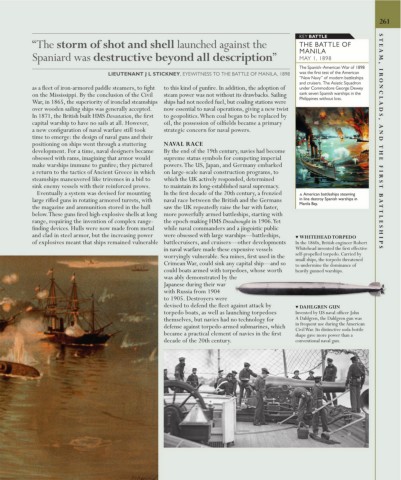
              Eventually a system was devised for mounting   In the first decade of the 20th century, a frenzied   ▲ American battleships steaming
            large rifled guns in rotating armored turrets, with   naval race between the British and the Germans   in line destroy Spanish warships in
                                                                                                            Manila Bay.
            the magazine and ammunition stored in the hull   saw the UK repeatedly raise the bar with faster,
            below. These guns fired high-explosive shells at long  more powerfully armed battleships, starting with
            range, requiring the invention of complex range-  the epoch-making HMS Dreadnought in 1906. Yet
            finding devices. Hulls were now made from metal   while naval commanders and a jingoistic public                            TTLESHIPS
            and clad in steel armor, but the increasing power   were obsessed with large warships—battleships,   ▼ WHITEHEAD TORPEDO
            of explosives meant that ships remained vulnerable  battlecruisers, and cruisers—other developments   In the 1860s, British engineer Robert
                                                           in naval warfare made these expensive vessels   Whitehead invented the first effective
                                                           worryingly vulnerable. Sea mines, first used in the   self-propelled torpedo. Carried by
                                                           Crimean War, could sink any capital ship—and so   small ships, the torpedo threatened
                                                                                                          to undermine the dominance of
                                                           could boats armed with torpedoes, whose worth   heavily gunned warships.
                                                           was ably demonstrated by the
                                                           Japanese during their war
                                                           with Russia from 1904
                                                           to 1905. Destroyers were
                                                           devised to defend the fleet against attack by   ▼ DAHLGREN GUN
                                                           torpedo boats, as well as launching torpedoes   Invented by US naval officer John
                                                           themselves, but navies had no technology for   A Dahlgren, the Dahlgren gun was
                                                           defense against torpedo-armed submarines, which   in frequent use during the American
                                                                                                          Civil War. Its distinctive soda-bottle
                                                           became a practical element of navies in the first   shape gave more power than a
                                                           decade of the 20th century.                    conventional naval gun.

