


Page 259 - (DK) Smithsinian - Military History: The Definitive Visual Guide to the Objects of Warfare
P. 259
257

                                                               GUERRILLA WARFARE
                                                               SECOND BOER WAR


                                                               In October 1899 the independent Boer republics of the                    SECOND BOER  W
                                                               Transvaal and the Orange Free State launched a preemptive
                                                               attack on British-ruled South Africa. The conflict later became
                                                               a guerrilla war, in which lightly armed, mounted Boer
                                                               commandos defied the military might of the British Empire.               AR


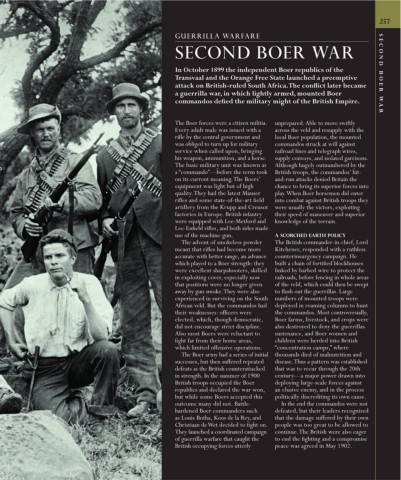
                                                               The Boer forces were a citizen militia.  unprepared. Able to move swiftly
                                                               Every adult male was issued with a   across the veld and resupply with the
                                                               rifle by the central government and   local Boer population, the mounted
                                                               was obliged to turn up for military   commandos struck at will against
                                                               service when called upon, bringing   railroad lines and telegraph wires,
                                                               his weapon, ammunition, and a horse.   supply convoys, and isolated garrisons.
                                                               The basic military unit was known as   Although hugely outnumbered by the
                                                               a “commando”—before the term took  British troops, the commandos’ hit-
                                                               on its current meaning. The Boers’   and-run attacks denied Britain the
                                                               equipment was light but of high     chance to bring its superior forces into
                                                               quality. They had the latest Mauser   play. When Boer horsemen did enter
                                                               rifles and some state-of-the-art field   into combat against British troops they
                                                               artillery from the Krupp and Creusot  were usually the victors, exploiting
                                                               factories in Europe. British infantry   their speed of maneuver and superior
                                                               were equipped with Lee-Metford and   knowledge of the terrain.
                                                               Lee-Enfield rifles, and both sides made
                                                               use of the machine-gun.             A SCORCHED EARTH POLICY
                                                                  The advent of smokeless powder   The British commander-in-chief, Lord
                                                               meant that rifles had become more   Kitchener, responded with a ruthless
                                                               accurate with better range, an advance   counterinsurgency campaign. He
                                                               which played to a Boer strength: they   built a chain of fortified blockhouses
                                                               were excellent sharpshooters, skilled  linked by barbed wire to protect the
                                                               in exploiting cover, especially now   railroads, before fencing in whole areas
                                                               that positions were no longer given   of the veld, which could then be swept
                                                               away by gun smoke. They were also   to flush out the guerrillas. Large
                                                               experienced in surviving on the South  numbers of mounted troops were
                                                               African veld. But the commandos had  deployed in roaming columns to hunt
                                                               their weaknesses: officers were     the commandos. Most controversially,
                                                               elected, which, though democratic,   Boer farms, livestock, and crops were
                                                               did not encourage strict discipline.   also destroyed to deny the guerrillas
                                                               Also most Boers were reluctant to   sustenance, and Boer women and
                                                               fight far from their home areas,    children were herded into British
                                                               which limited offensive operations.   “concentration camps,” where
                                                                  The Boer army had a series of initial  thousands died of malnutrition and
                                                               successes, but then suffered repeated   disease. Thus a pattern was established
                                                               defeats as the British counterattacked   that was to recur through the 20th
                                                               in strength. In the summer of 1900   century—a major power drawn into
                                                               British troops occupied the Boer    deploying large-scale forces against
                                                               republics and declared the war won,   an elusive enemy, and in the process
                                                               but while some Boers accepted this   politically discrediting its own cause.
                                                               outcome many did not. Battle-         In the end the commandos were not
                                                               hardened Boer commanders such       defeated, but their leaders recognized
                                                               as Louis Botha, Koos de la Rey, and   that the damage suffered by their own
                                                               Christiaan de Wet decided to fight on.  people was too great to be allowed to
                                                               They launched a coordinated campaign  continue. The British were also eager
                                                               of guerrilla warfare that caught the   to end the fighting and a compromise
                                                               British occupying forces utterly    peace was agreed in May 1902.

