


Page 264 - (DK) Smithsinian - Military History: The Definitive Visual Guide to the Objects of Warfare
P. 264
262

            BATTLESHIPS
         AND IMPERIALISM 1815–1914
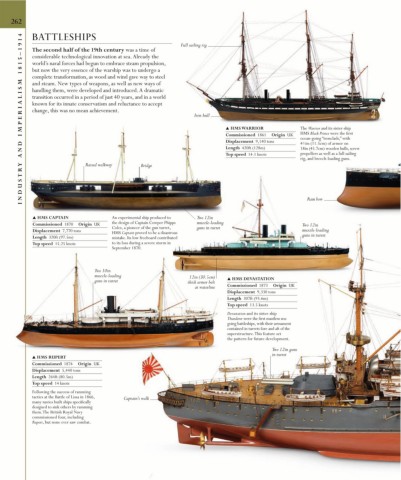
                                                                 Full sailing rig
            The second half of the 19th century was a time of
            considerable technological innovation at sea. Already the
            world’s naval forces had begun to embrace steam propulsion,
            but now the very essence of the warship was to undergo a
            complete transformation, as wood and wind gave way to steel
            and steam. New types of weapons, as well as new ways of
            handling them, were developed and introduced. A dramatic
            transition occurred in a period of just 40 years, and in a world
            known for its innate conservatism and reluctance to accept
            change, this was no mean achievement.
                                                                      Iron hull

                                                                                 ▲ HMS WARRIOR              The Warrior and its sister-ship
                                                                                 Commissioned  1861     Origin  UK  HMS Black Prince were the first
                                                                                                            ocean-going “ironclads,” with
                                                                                 Displacement  9,140 tons
                                                                                                            4½in (11.5cm) of armor on
                                                                                 Length  420ft (128m)       18in (45.7cm) wooden hulls, screw
                                                                                 Top speed  14.1 knots      propellers as well as a full sailing
                                                                                                            rig, and breech-loading guns.
         Y                     Raised walkway      Bridge
         INDUSTR                                                                                              Ram bow


            ▲ HMS CAPTAIN                An experimental ship produced to    Two 12in
            Commissioned  1870     Origin  UK  the design of Captain Cowper Phipps   muzzle-loading          Two 12in
                                         Coles, a pioneer of the gun turret,   guns in turret
            Displacement  7,770 tons                                                                         muzzle-loading
                                         HMS Captain proved to be a disastrous
            Length  320ft (97.5m)        mistake. Its low freeboard contributed                              guns in turret
            Top speed  15.25 knots       to its loss during a severe storm in
                                         September 1870.


                                   Two 10in
                                   muzzle-loading                   12in (30.5cm)
                                   guns in turret                   thick armor belt     ▲ HMS DEVASTATION
                                                                      at waterline  Commissioned  1873     Origin  UK
                                                                                  Displacement  9,330 tons
                                                                                  Length  307ft (93.6m)
                                                                                  Top speed  13.5 knots
                                                                                  Devastation and its sister-ship
                                                                                  Thunderer were the first mastless sea-
                                                                                  going battleships, with their armament
                                                                                  contained in turrets fore and aft of the
                                                                                  superstructure. This feature set
                                                                                  the pattern for future development.
                                                                                                  Two 12in guns
                                                                                                  in turret
            ▲ HMS RUPERT
            Commissioned  1874     Origin  UK
            Displacement  5,440 tons
            Length  264ft (80.5m)
            Top speed  14 knots
            Following the success of ramming
            tactics at the Battle of Lissa in 1866,   Captain’s walk
            many navies built ships specifically
            designed to sink others by ramming
            them. The British Royal Navy
            commissioned four, including
            Rupert, but none ever saw combat.

