


Page 266 - (DK) Smithsinian - Military History: The Definitive Visual Guide to the Objects of Warfare
P. 266
264

            THE AGE OF STEAM AND BIG GUN
         AND IMPERIALISM 1815–1914
            THE BATTLE


            OF TSUSHIMA


            In the second half of the 19th century, new technology
            transformed the world’s navies. Wooden sailing ships were
            replaced by steel warships with coal-fired engines, armed
            with powerful rifled guns in rotating turrets. The Russians
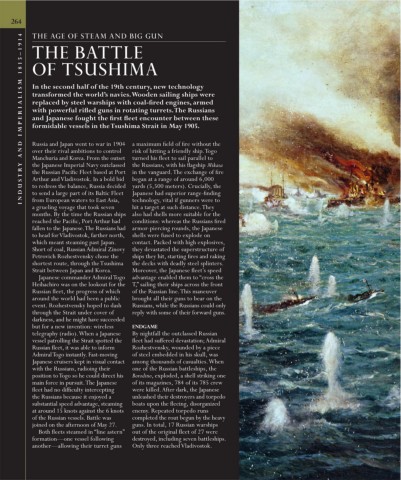
            and Japanese fought the first fleet encounter between these
            formidable vessels in the Tsushima Strait in May 1905.


            Russia and Japan went to war in 1904  a maximum field of fire without the
            over their rival ambitions to control   risk of hitting a friendly ship. Togo
            Manchuria and Korea. From the outset  turned his fleet to sail parallel to
         Y   the Japanese Imperial Navy outclassed  the Russians, with his flagship Mikasa
         INDUSTR  Arthur and Vladivostok. In a bold bid  began at a range of around 6,000
            the Russian Pacific Fleet based at Port  in the vanguard. The exchange of fire

            to redress the balance, Russia decided  yards (5,500 meters). Crucially, the
                                                Japanese had superior range-finding
            to send a large part of its Baltic Fleet
            from European waters to East Asia,
                                                hit a target at such distance. They
            a grueling voyage that took seven   technology, vital if gunners were to
            months. By the time the Russian ships  also had shells more suitable for the
            reached the Pacific, Port Arthur had   conditions: whereas the Russians fired
            fallen to the Japanese. The Russians had  armor-piercing rounds, the Japanese
            to head for Vladivostok, farther north,  shells were fused to explode on
            which meant steaming past Japan.    contact. Packed with high explosives,
            Short of coal, Russian Admiral Zinovy  they devastated the superstructure of
            Petrovich Rozhestvensky chose the   ships they hit, starting fires and raking
            shortest route, through the Tsushima   the decks with deadly steel splinters.
            Strait between Japan and Korea.     Moreover, the Japanese fleet’s speed
               Japanese commander Admiral Togo  advantage enabled them to “cross the
            Heihachiro was on the lookout for the  T,” sailing their ships across the front
            Russian fleet, the progress of which   of the Russian line. This maneuver
            around the world had been a public   brought all their guns to bear on the
            event. Rozhestvensky hoped to dash   Russians, while the Russians could only
            through the Strait under cover of   reply with some of their forward guns.
            darkness, and he might have succeeded
            but for a new invention: wireless   ENDGAME
            telegraphy (radio). When a Japanese   By nightfall the outclassed Russian
            vessel patrolling the Strait spotted the   fleet had suffered devastation; Admiral
            Russian fleet, it was able to inform   Rozhestvensky, wounded by a piece
            Admiral Togo instantly. Fast-moving   of steel embedded in his skull, was
            Japanese cruisers kept in visual contact  among thousands of casualties. When
            with the Russians, radioing their   one of the Russian battleships, the
            position to Togo so he could direct his   Borodino, exploded, a shell striking one
            main force in pursuit. The Japanese   of its magazines, 784 of its 785 crew
            fleet had no difficulty intercepting    were killed. After dark, the Japanese
            the Russians because it enjoyed a   unleashed their destroyers and torpedo
            substantial speed advantage, steaming   boats upon the fleeing, disorganized
            at around 15 knots against the 6 knots   enemy. Repeated torpedo runs
            of the Russian vessels. Battle was   completed the rout begun by the heavy
            joined on the afternoon of May 27.  guns. In total, 17 Russian warships
               Both fleets steamed in “line astern”  out of the original fleet of 27 were
            formation—one vessel following      destroyed, including seven battleships.
            another—allowing their turret guns    Only three reached Vladivostok.

