


Page 278 - (DK) Smithsinian - Military History: The Definitive Visual Guide to the Objects of Warfare
P. 278
INTRODUCTION


            The two world wars, from 1914 to 1918, and                    to aircraft carriers, while submarines established
            from 1939 to 1945, were the most destructive                  themselves, unexpectedly, as potentially war-winning
            conflicts in human history. In terms of                       commerce raiders.
            technology, the period was marked by the                        The tank, a useful—if clumsy—adjunct to World War I
            spectacular development of aviation and                       infantry operations, was vital to the fast-moving motorized
            of motorized warfare, especially tanks.                       warfare of World War II, when coordinated by radio with
                                                                          ground-attack aircraft serving as aerial artillery. The motor

            The pace of development was by no means even. Infantry        truck eventually made horse-drawn transport obsolete,
            firepower increased over time, from the introduction of       although, as late as 1941, Germany still used hundreds of
            light machine-guns and mortars, to sub-machine-guns,          thousands of horses for its invasion of the Soviet Union.
            automatic rifles, and, late in World War II, assault rifles.    The pressure of war generated a search for “wonder
            But there is no comparison between this scale of change       weapons,” as scientists were enlisted to help the military
            and the absolute transformation of aerial warfare.            effort. Poison gas proved indecisive in World War I, and
            Armies entered World War I with a few hundred flimsy,         chemical weapons were not used between 1939 and 1945.
            unarmed reconnaissance aircraft. By 1945, however,            The jet aircraft, V-1 flying bomb, and V-2 ballistic missile
            fleets of thousands of multi-engined bombers were able        were all introduced by Germany late in World War II, without
            to devastate enemy cities, while ground forces could          affecting the outcome of the conflict; however, the atom
            barely operate if their opponents controlled the skies.       bomb, developed by the United States between 1942 and
            Dominance in naval battles shifted from large battleships     1945 at vast cost, truly heralded a new era in warfare.


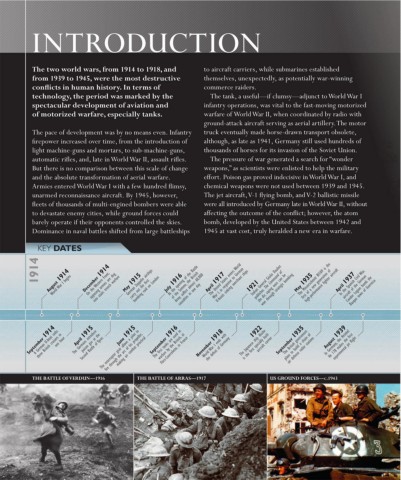
              KEY DATES
              1914  August 1914   December 1914   May 1915   July 1916     April 1917     1921  the Air, saying wars can be   May 1935   April 1937
                                                                                                            The Messerschmitt Bf109 is the
                                                                            The United States enters World
                                                                                           Italian General Giulio Douhet
                                                             At the opening of the Battle
                                                                             War I, in response to German
                                               German Zeppelin airships
                                                                                                             first of a new generation of
                                                                                                                           In the Spanish Civil War,
                                                                                                              high-performance fighter aircraft
                                                                              U-boats sinking merchant ships
                                                                                            publishes The Command of
                                                               of the Somme, the British
                                 opposing armies are dug
                                On the Western Front,
                                                                Army suffers almost 60,000
                                                                                                                            aircraft of the German
                                                                                               won through strategic bombing
                                                                                                                             Condor Legion bomb the
                   World War I begins
                                   into static trench warfare
                                                 bombing raid on London
                                                carry out the first
                                                                                                                              Basque town of Guernica
                                                                 casualties in one day
                            April 1915
           September 1914  one hour  The Germans introduce        The interrupter gear allows a pilot to   September 1916      November 1918        The Japanese ship Hosho      September 1935     August 1939
                                                                                           1922
                                           June 1915
                                                                                                      The British government
                                                        The first tanks are used in
             A German U-boat sinks
                                                                                                                     In Germany, the Heinkel
                                                                                                                       He 178 makes the first
                                                                                                       plans to build a chain of
                              poison gas at the
                                                          warfare by the British, at
                                       fire through the arc of his propeller,
               three British cruisers in
                                                                                        is the first specially built
                                                                          World War I ends with
                                                                                             aircraft carrier
                                                                                                                        experimental jet flight
                                           making air combat practical
                              Second Battle of Ypres
                                                           Flers-Courcelette, in France
                                                                                                        air defense radar stations
                                                                           the defeat of Germany
            THE BATTLE OF VERDUN—1916             THE BATTLE OF ARRAS—1917                       US GROUND FORCES—C.1943

