


Page 288 - (DK) Smithsinian - Military History: The Definitive Visual Guide to the Objects of Warfare
P. 288
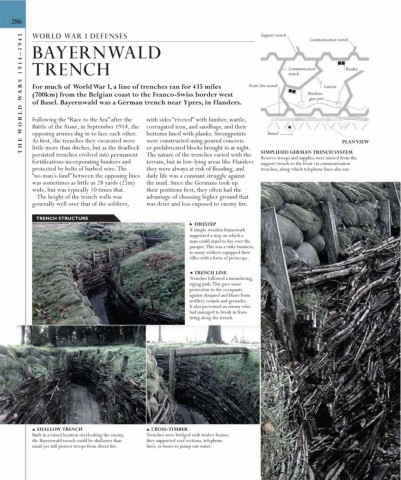
286    WORLD WAR I DEFENSES                                                              Support trench

         1914–1945  BAYERNWALD                                                                                 Communication trench


         ARS  TRENCH                                                                      Front line trench  Communication   Latrine  Bunker

                                                                                                        trench
            For much of  World War I, a line of trenches ran for 435 miles
                                                                                                               Machine-
         ORLD W  (700km) from the Belgian coast to the Franco-Swiss border west                                gun post
            of Basel. Bayernwald was a German trench near  Ypres, in Flanders.


            Following the “Race to the Sea” after the
                                                     with sides “riveted” with lumber, wattle,
            Battle of the Aisne, in September 1914, the  corrugated iron, and sandbags, and their
         THE W  opposing armies dug in to face each other.   bottoms lined with planks. Strongpoints   Tunnel              PLAN VIEW
                                                     were constructed using poured concrete
            At first, the trenches they excavated were
            little more than ditches, but as the deadlock  or prefabricated blocks brought in at night.
            persisted trenches evolved into permanent   The nature of the trenches varied with the   SIMPLIFIED GERMAN  TRENCH SYSTEM
            fortifications incorporating bunkers and   terrain, but in low-lying areas like Flanders   Reserve troops and supplies were moved from the
                                                                                              support trench to the front via communication
            protected by belts of barbed wire. The   they were always at risk of flooding, and   trenches, along which telephone lines also ran.
            “no-man’s-land” between the opposing lines  daily life was a constant struggle against
            was sometimes as little as 28 yards (25m)   the mud. Since the Germans took up
            wide, but was typically 10 times that.   their positions first, they often had the
              The height of the trench walls was     advantage of choosing higher ground that
            generally well over that of the soldiers,   was drier and less exposed to enemy fire.


              TRENCH STRUCTURE
                                                                     ▶ FIRESTEP
                                                                     A simple wooden framework
                                                                     supported a step on which a
                                                                     man could stand to fire over the
                                                                     parapet. This was a risky business,
                                                                     so many soldiers equipped their
                                                                     rifles with a form of periscope.

                                                                     ◀ TRENCH LINE
                                                                     Trenches followed a meandering,
                                                                     zigzag path. This gave some
                                                                     protection to the occupants
                                                                     against shrapnel and blasts from
                                                                     artillery rounds and grenades.
                                                                     It also prevented an enemy who
                                                                     had managed to break in from
                                                                     firing along the trench.


            ▲ SHALLOW  TRENCH                        ▲ CROSS-TIMBER
            Built in a raised location overlooking the enemy,    Trenches were bridged with timber beams;
            the Bayernwald trench could be shallower than   they supported roof sections, telephone
            usual yet still protect troops from direct fire.  lines, or hoses to pump out water.

