


Page 285 - (DK) Smithsinian - Military History: The Definitive Visual Guide to the Objects of Warfare
P. 285
283


                                                                                                     Optical sight
                                                                                  Cooling fins                                          HEA VY MA


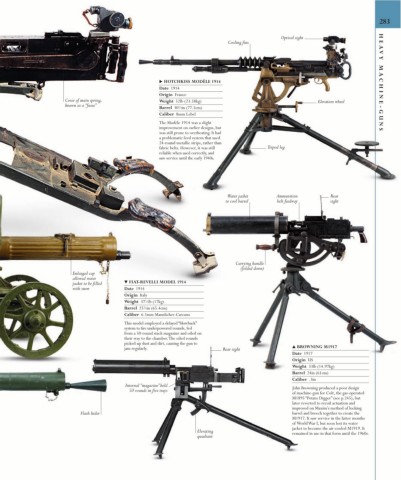
                                                          ▶ HOTCHKISS MODÈLE 1914
                                                          Date  1914
                                                          Origin  France
                        Cover of main spring,             Weight  52lb (23.58kg)                                  Elevation wheel
                        known as a  “fusee”                                                                                             CHINE-GUNS
                                                          Barrel  30 ⁄2in (77.5cm)
                                                                 1
                                                          Caliber  8mm Lebel
                                                          The Modèle 1914 was a slight
                                                          improvement on earlier designs, but
                                                          was still prone to overheating. It had
                                                          a problematic feed system that used
                                                          24-round metallic strips, rather than
                                                          fabric belts. However, it was still   Tripod leg
                                                          reliable when used correctly, and
                                                          saw service until the early 1940s.


                                                                                  Water jacket      Ammunition         Rear
                                                                                 to cool barrel     belt feedway       sight


                                                                                     Carrying handle
                                                                                       (folded down)
                           Enlarged cap
                           allowed water
                           jacket to be filled   ▼ FIAT-REVELLI MODEL 1914
                           with snow         Date  1914
                                             Origin  Italy
                                                     1
                                             Weight  37 ⁄2lb (17kg)
                                                    3
                                             Barrel  25 ⁄4in (65.4cm)
                                             Caliber  6.5mm Mannlicher-Carcano
                                             This model employed a delayed “blowback”
                                             system to fire underpowered rounds, fed
                                             from a 50-round stack magazine and oiled on
                                             their way to the chamber. The oiled rounds
                                             picked up dust and dirt, causing the gun to
                                             jam regularly.                     Rear sight               ▲ BROWNING M1917
                                                                                                         Date  1917
                                                                                                         Origin  US
                                                                                                         Weight  33lb (14.97kg)
                                                                                                         Barrel  24in (61cm)
                                                                                                         Caliber  .3in
                                              Internal  “magazine” held                                  John Browning produced a poor design
                                               50 rounds in five trays
                                                                                                         of machine-gun for Colt, the gas-operated
                                                                                                         M1895 “Potato Digger” (see p.245), but
                                                                                                         later reverted to recoil actuation and
                                                                                                         improved on Maxim’s method of locking
                              Flash hider                                                                barrel and breech together to create the
                                                                                                         M1917. It saw service in the latter months
                                                                                                         of  World War I, but soon lost its water
                                                                                                         jacket to become the air-cooled M1919. It
                                                                       Elevating                         remained in use in that form until the 1960s.
                                                                       quadrant

